Dear Friend,
We would be so grateful if you would make a charitable donation to support the Bruce Peninsula Bird Observatory (BPBO) this year. I will be spending an entire day observing as many birds as possible to raise funds for BPBO through the Great Canadian Birdathon. This year, I hope to do my birdathon around BPBO’s migration monitoring station at Cabot Head where I will be volunteering for the migration monitoring program later in May. Click here to go directly to my support page.
Let me tell you about Bruce Peninsula Bird Observatory. A few of us who loved the upper Bruce and especially the Cabot Head area, founded BPBO in 2001, establishing a research station on Ontario Park’s Cabot Head Nature Reserve to track the spring and fall migrations which we’ve done ever since. As I described last year, BPBO is facing many logistical and financial challenges. Some things are getting fixed, and fortunately our dependable Station Scientist Stephane, is back again to run the migration monitoring program. As in the past two years, our ability to raise funds through the rental of our research station property between spring and fall has been compromised. We still need to increase our solar energy capacity to assure a reliable energy source. Birdathon has become a key source of funding. In 2021, thanks to your generosity, we raised over $5000, of which over $4000 went to BPBO. This is outstanding and gives us an ambitious target which we can achieve together.
Please donate to my Corvid 22 BPBO team if you are a BPBO supporter, if you just love birds or the Bruce, or if you know me, and how much this means to me. Again, I donated $100 myself. It would be amazing if you could match or surpass my donation and help BPBO survive and thrive.
Let me tell you a bit about the day. I will share a post about my birdathon here on my own blog https://birdingfromthebalcony.ca/. I put a lot of energy into the birdathon, but it’s green energy. I’ll only be travelling by foot or bicycle. Typically I start around 4 am and go until it’s too dark to see. I plan to spend much of the morning at Cabot Head, then ride my bike perhaps as far as Crane lake. I hope to see hundreds of species, but will be lucky probably to observe 100.
Please give generously to my birdathon for BPBO this year. Birds Canada will issue you a tax receipt for donations over $15. Use this link to get to the donation page: https://www.canadahelps.org/s/FjNst
I will provide live updates on my progress on my Facebook and Instagram pages and give the full account on my blog.
Thank you in advance!
Ted
The last post about the joy of birding from the place where I live was April 22, 2021. Twelve months later, and 16 months into our house on the street named after the Goldfinch tells me that an update blog post is overdue to say the least. I say that with a modicum of shame. Last year, in a rash move to commit more time to writing in my blog, I purchased a two-year subscription with Word Press, with some fancy updates as well as a subscription in Master Class. My wife raised an eyebrow when I told her about this, but I was determined to write more, and improve my story telling. “So how’s that been?” someone might sarcastically ask me today, and rightly so. It’s sucked – no way around it. Zero posts since my birdathon post last May, which I do not really count as a post. No excuses.
That’s not to say I haven’t found time to bird since mid-April last year. I have indeed. It turns out birding is easier, and more fun than writing. Anyway, returning to subject of birding from our new house, the options here are more pleasant than our previous apartment, as charming as it was. Here we have a lovely backyard, three mature trees, copious seed-bearing perennials and wildflowers, and an amazing neighbourhood with over 40% forest cover that I describe in the previous post here.
I enjoy the thought of being able to observe 100 species within a calendar year from my own yard. That seems like a decent target that requires a commitment of time and maintenance of my bird identification skills. In the 10 years that I kept records from rue Boucherville, I hit or surpassed 100 species three times: 100 in 2016, 102 in 2019, and 112 in 2020. Therefore, I was very curious to know what the new house would offer.
We spent the first couple of months in our new abode fixing things and moving in, hence there was little time for birding. By mid April I was able to enjoy the yard more and grow the bird list. By the end of April, I had observed 52 species, and by the end of May, an impressive 94 species. Not even five months and nearly 100 species! We had moved into bird heaven no less, it appeared. I figured that, even without any luck, I could easily challenge the mega year of 112 species at rue Boucherville.
Birding in May had many highlights. One was a flock of 85 Brant flying over the house on May 16th. Like so many species, I heard them first, then spotted a long line of Brant flying from east to west. Brant have a distinctive cackling call that sounds a bit like barnyard geese. In Gatineau and Ottawa, Brant are a regular treat each year, passing through for a few days on their migration between the Atlantic Ocean and the Arctic where they breed. I’ve learned in the last few years that one needs to be alert and outside in mid to late May to notice this ephemeral migrant pass through the region. On the 19th I heard a Wood Thrush’s ethereal song from the nearby forest. The same day, a Bobolink announced its presence as it flew high over our neighbourhood. Lucky for me, I happened to be listening and detected its distinctive flight call. Both of these species are species at risk, so hearing them is both a treat and an alert to their plight. Knowing the songs and call notes is one of the keys to identifying a large number of species from a house or a yard, as often one doesn’t see the bird. Of course it doesn’t matter how good your identification skills are if you don’t put in the hours outside or listening from an open window. Fortunately, for me, I was also outside listening when an Eastern Bluebird, a Killdeer and a Common Loon vocalized while flying over, on their way somewhere to the north of us.
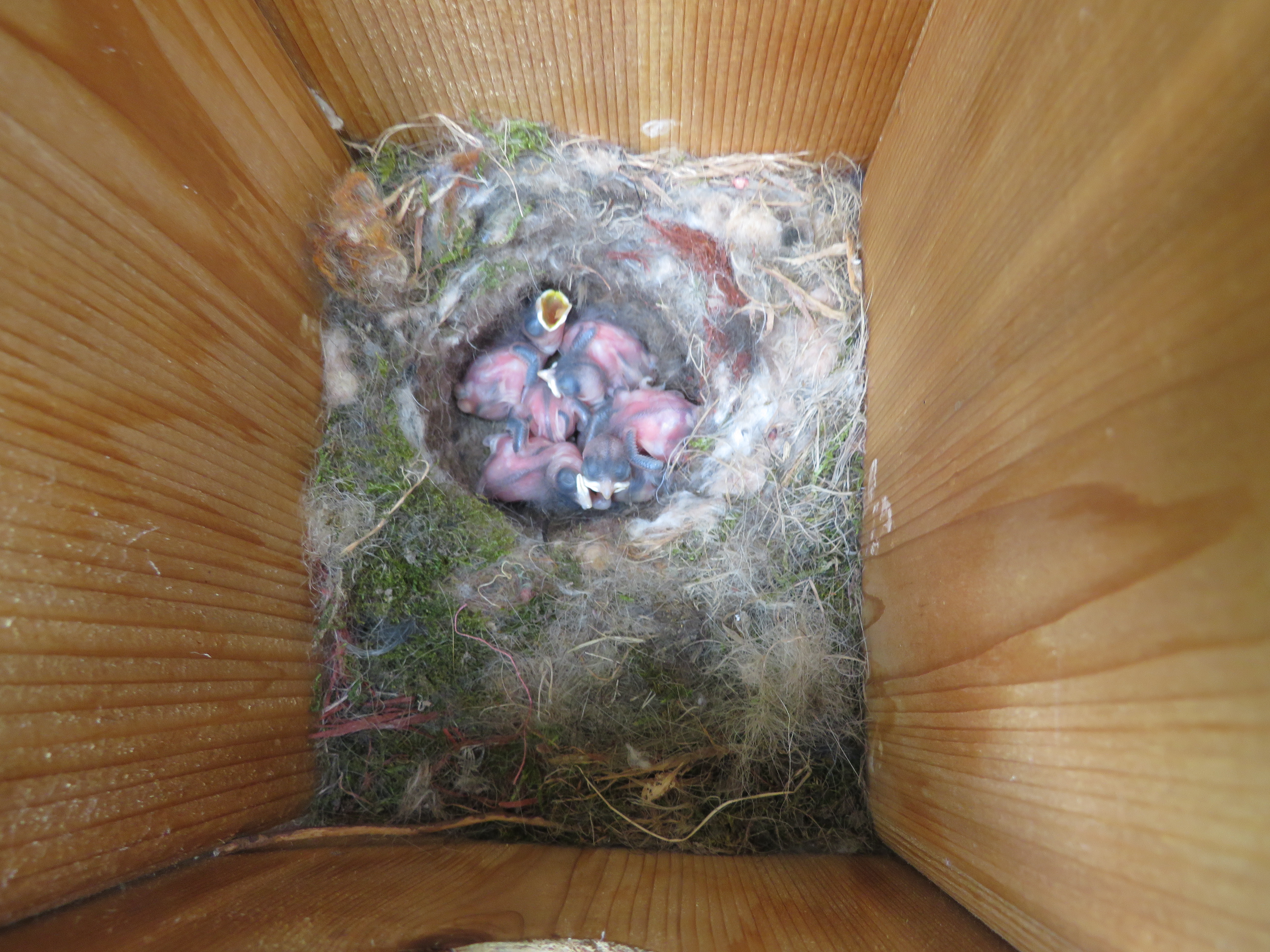
In June, another highlight came from the nest box attached to the garden shed. A pair of Black-capped Chickadees took up occupancy in early May. In mid-June, their nest fledged all six young! Congratulations Chickadee family! This same nest box fledged young on our balcony on Boucherville in 2020. Certainly, it must be a good house for Chickadees! I watched the adults collecting food on several occasions. Sometimes there were only three to five minutes between feedings and other times over 20 minutes. The Chickadees were so good at gleaning caterpillars and other arthropods from the foliage, trees and shrubs in our yard. Based on my observations, I calculated that the pair consumed 15,000 caterpillars by the time their chicks fledged. One nesting pair of Chickadees = healthy trees!
On June 10, a Yellow-billed Cuckoo wandered into our yard, announcing itself with a loud song and then was gone just as quickly. The abundance of Tent Caterpillars and Gypsy Moth caterpillars undoubtedly fed many Cuckoo nestlings in the Outaouais in 2021.
On June 18, I observed the 98th species, a Common Yellowthroat, likely a young wandering male, heard singing from the nearby forest. After that, remarkably, I only observed three more species: one in July, one in August, and the last, a Red-tailed Hawk, on October 5, for 101 species in 2021 from my house and yard. The lesson is within this a very appropriate axiom involving birds: don’t count your chickens before the eggs hatch.
Notes on adding habitat for birds
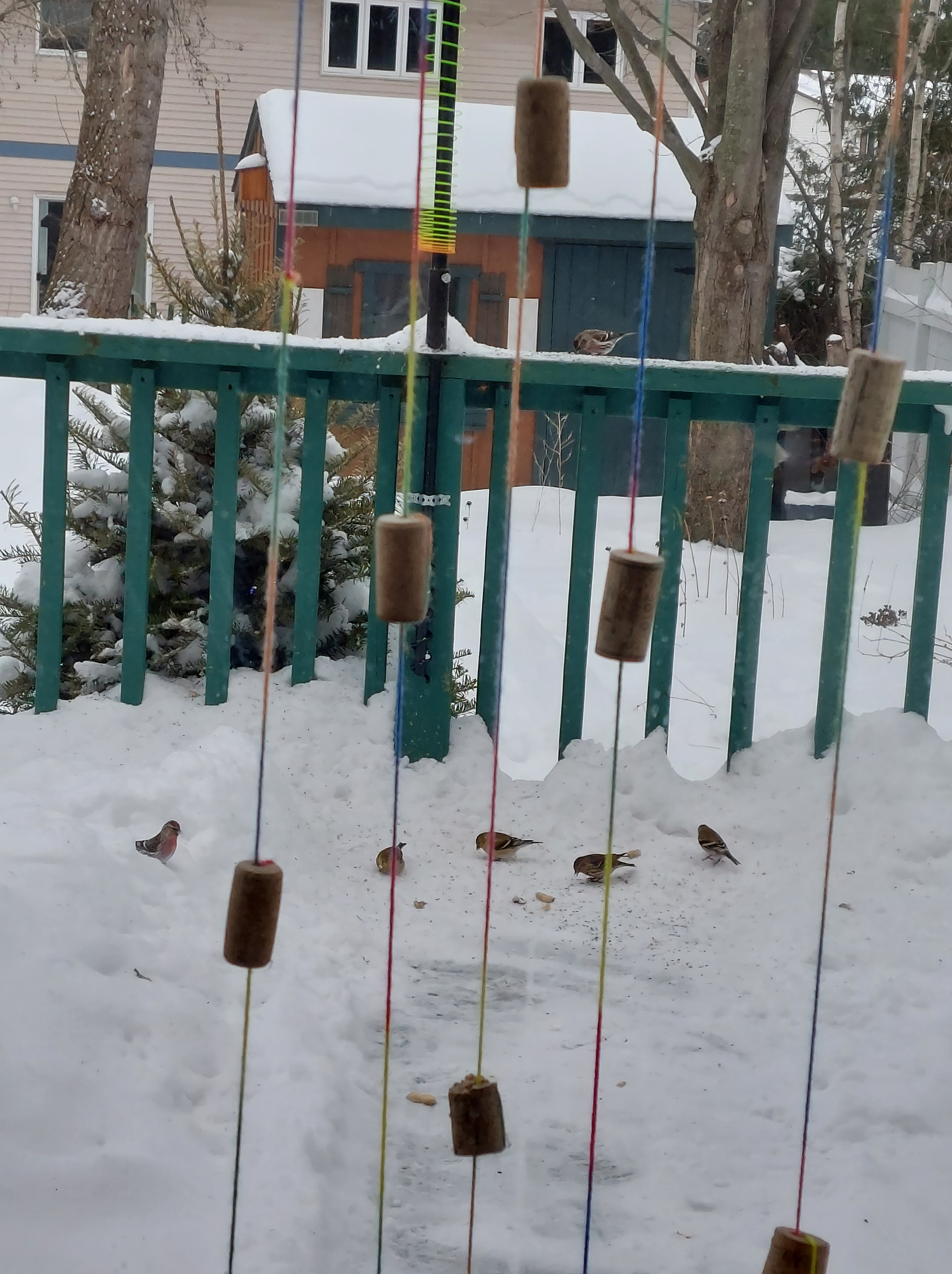
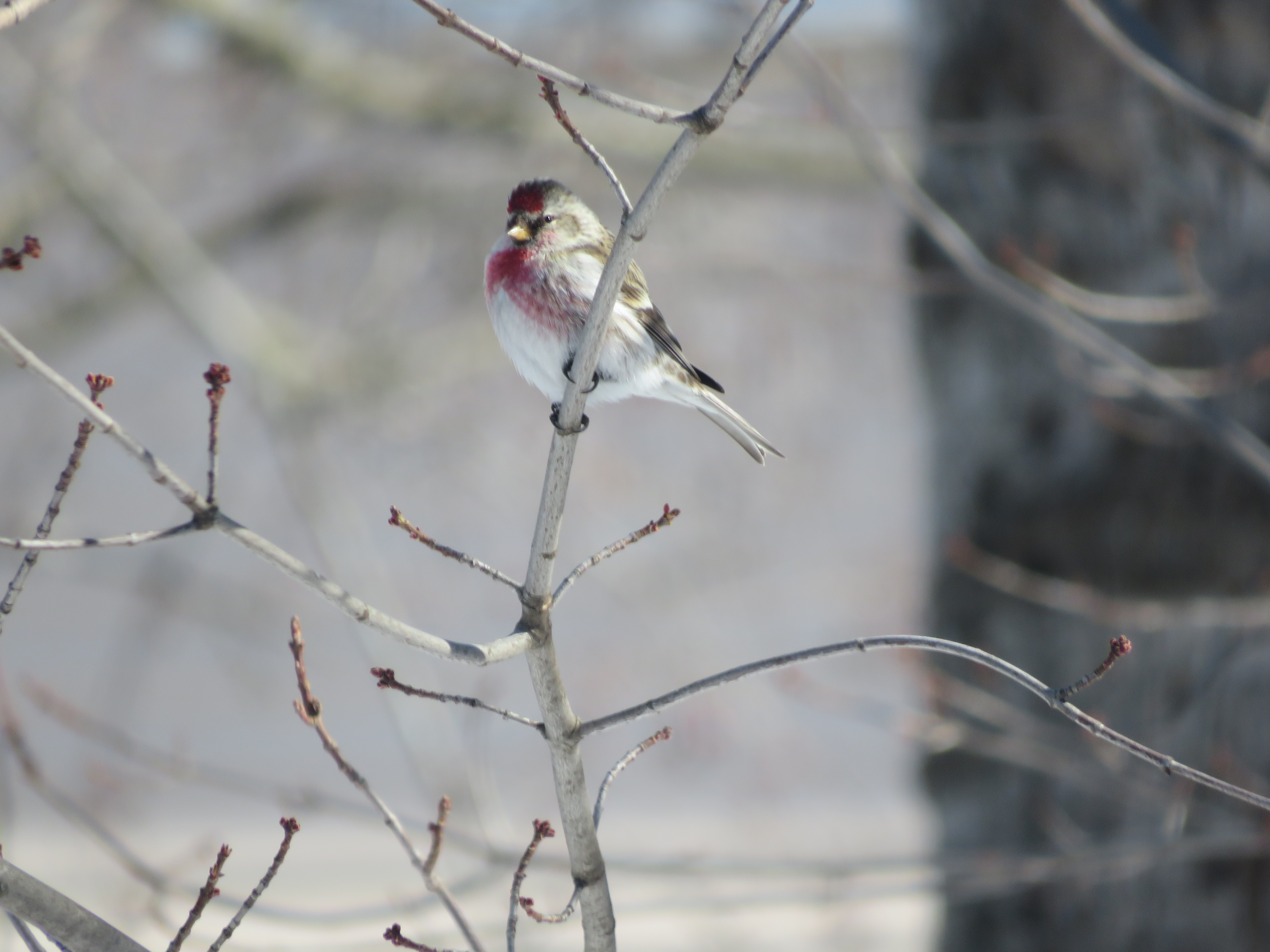
In the fall, we installed a triple bird feeder that sits atop a three-metre metal pole, secured to the back of the deck. After some trial and error, we added an effective squirrel deterrent that involves two slinkies and weekly applications of vegetable oil. The feeders include a peanut feeder for the Jays, a sunflower (shelled) feeder that is a hit with Goldfinches, Pine Siskins, Common Redpolls and a few Hoary Redpolls, Black-capped Chickadees and White-breasted Nuthatches, and a nyger feeder that gets the least traffic. At least one of the resident Chickadees always stops to peck at the nyger feeder first.
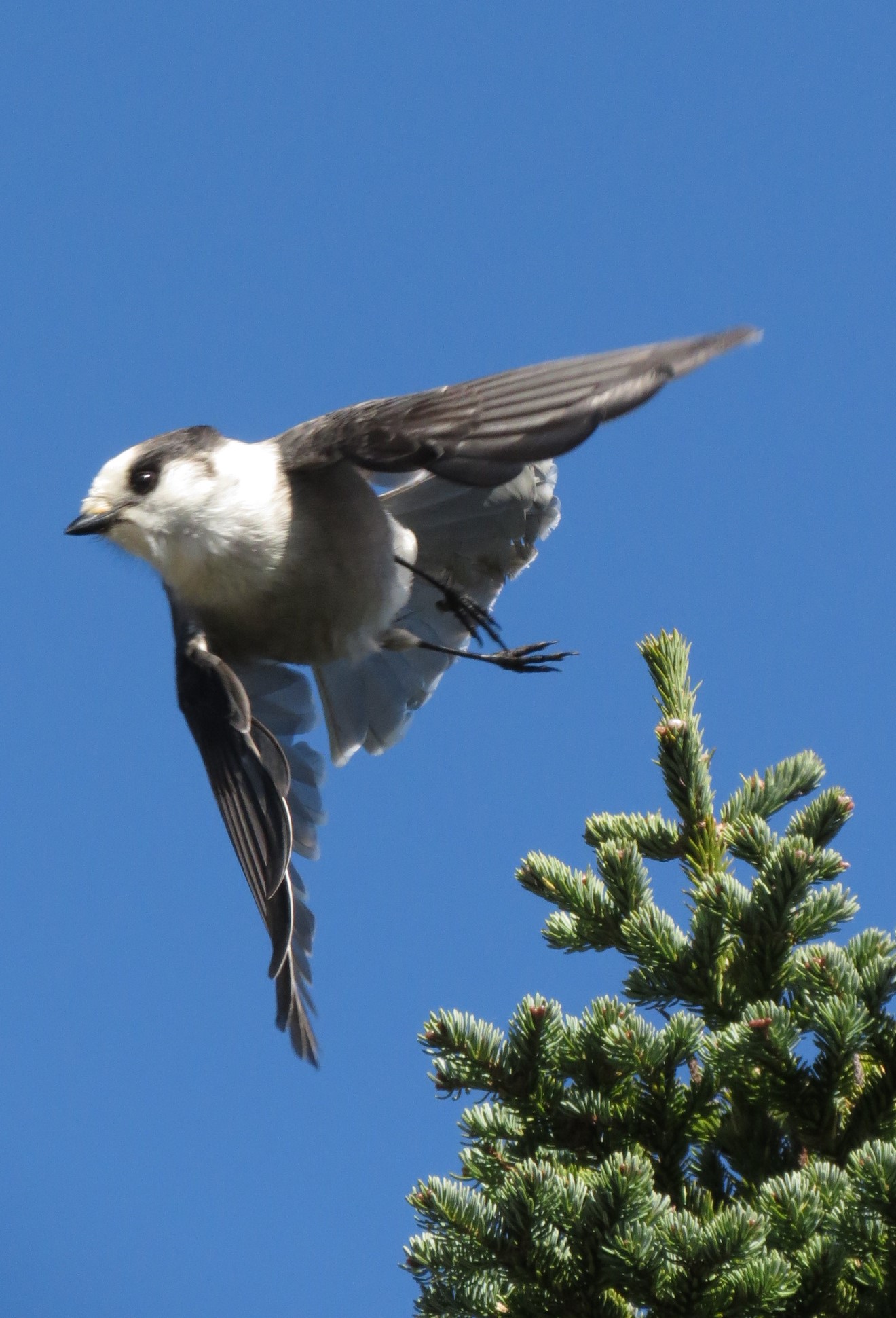
The Jays are always interesting characters to watch. One of the unusual behaviours that we have observed, that adds some validity to the idea that animals cooperate with each other, involves at least one Jay regularly throwing one or more peanuts in the shell to the deck below (sometimes three or four) before taking one or two. Sometimes the Gray Squirrels are standing on their back legs, looking longingly up at the feeder with the big Blue Jays, and occasionally they get rewarded.
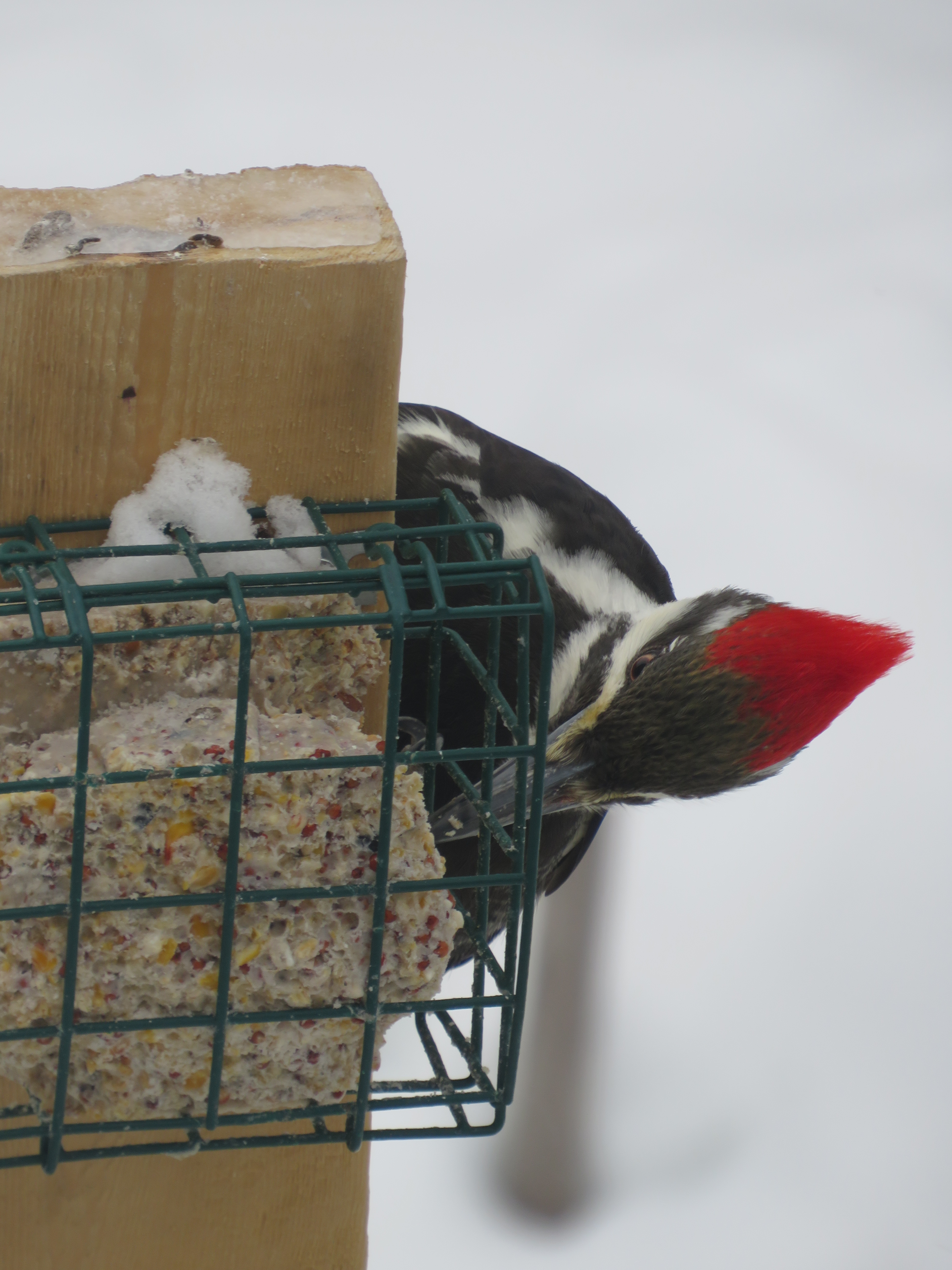
We also have a suet feeder and water containers. The suet feeder was eventually discovered by the big guy, who visited regularly through the winter to feast on wild grapes growing amongst the tree branches in the back of our yard.
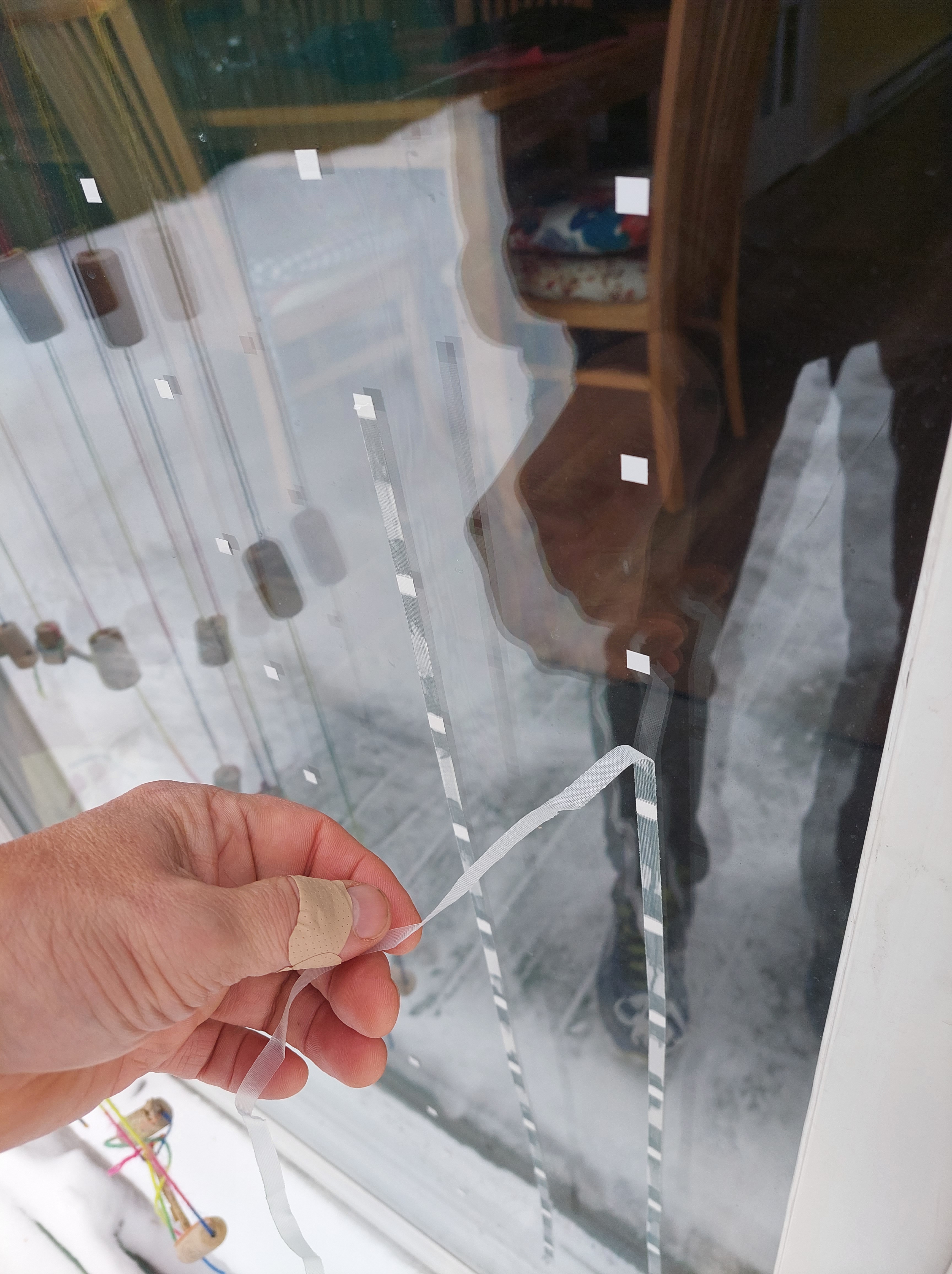
We made the sliding glass doors onto the deck safe (they are only about 4 or 5 m from the feeders), by hanging strings on wool, weighted by wine corks, as well as some feather-friendly tape markings. I am 100% sure that this has prevented many collisions. Everyone should take a few minutes to save bird lives in this way. Solutions can be simple like ours. Birds don’t see glass, just the reflections, or what’s on the other side.
Did you know that there are 30% fewer birds in North America now then there were 50 years ago? Human actions are behind the population drop. Human actions must also drive the recovery. Birds need our help. We can’t wait for someone else to do it. One way of helping is through a generous donation to the Great Canadian Birdathon. If you have not already supported me, I humbly request your generosity and support this year. As I write this account, the CORVID-21 team has raised $3,470. With you support, we can make it to the magic $5,000! Please click on this link to go to the support page if you have not already done so.
The Bruce Peninsula Bird Observatory (BPBO), a nonprofit charity, does much to help save bird lives. BPBO’s work includes excellent science to track bird populations over time, training of young ornithologists to become passionate bird advocates, and standing up for birds on the Bruce Peninsula, an important migration corridor in Ontario and one of the most unique landscapes in Southern Canada.
Your support for my birdathon means so much for BPBO. It’s been an extremely tough year for BPBO due to COVID, the extremely high water levels that washed out the road into the research station, and damage to the electrical lines coming into the station. Your support will help us reach our goal of doubling our solar energy capacity so that we can operate our migration monitoring station without interruption.
Let me tell you about my birdathons. Yes, it is plural. I took a couple days off work, to do two birdathons. Thursday, May 20, I spent several hours on my bicycle doing reconnaissance of my new area. It is always worthwhile to scout an area prior to the “big day” as many of the birds, especially the territorial ones can be relocated the next day, and make a big day more efficient. As we moved into our new neighbourhood in January, a few kilometres to the west of where we had lived for the last decade, I didn’t know the surroundings that well, particularly the large forest near our new house. The new neighbourhood is very forested. Local birders call the nearby forest “la Foret Chantegrives” or “Thrush Song Woods,” and according to a 1930 map the entire area was a bird sanctuary at one time. Now the subdivision streets, including our own, have bird names bearing testament to this sanctuary. As is often the case with housing developments, streets are named after some nature feature that was destroyed when the land was cleared. Fortunately some of that natural features are still intact and functioning nicely. A sign of this during reconnaissance on Thursday, was that I located 57 species in less than two hours in my neighbourhood, boding well for birdathon Friday.
Friday:
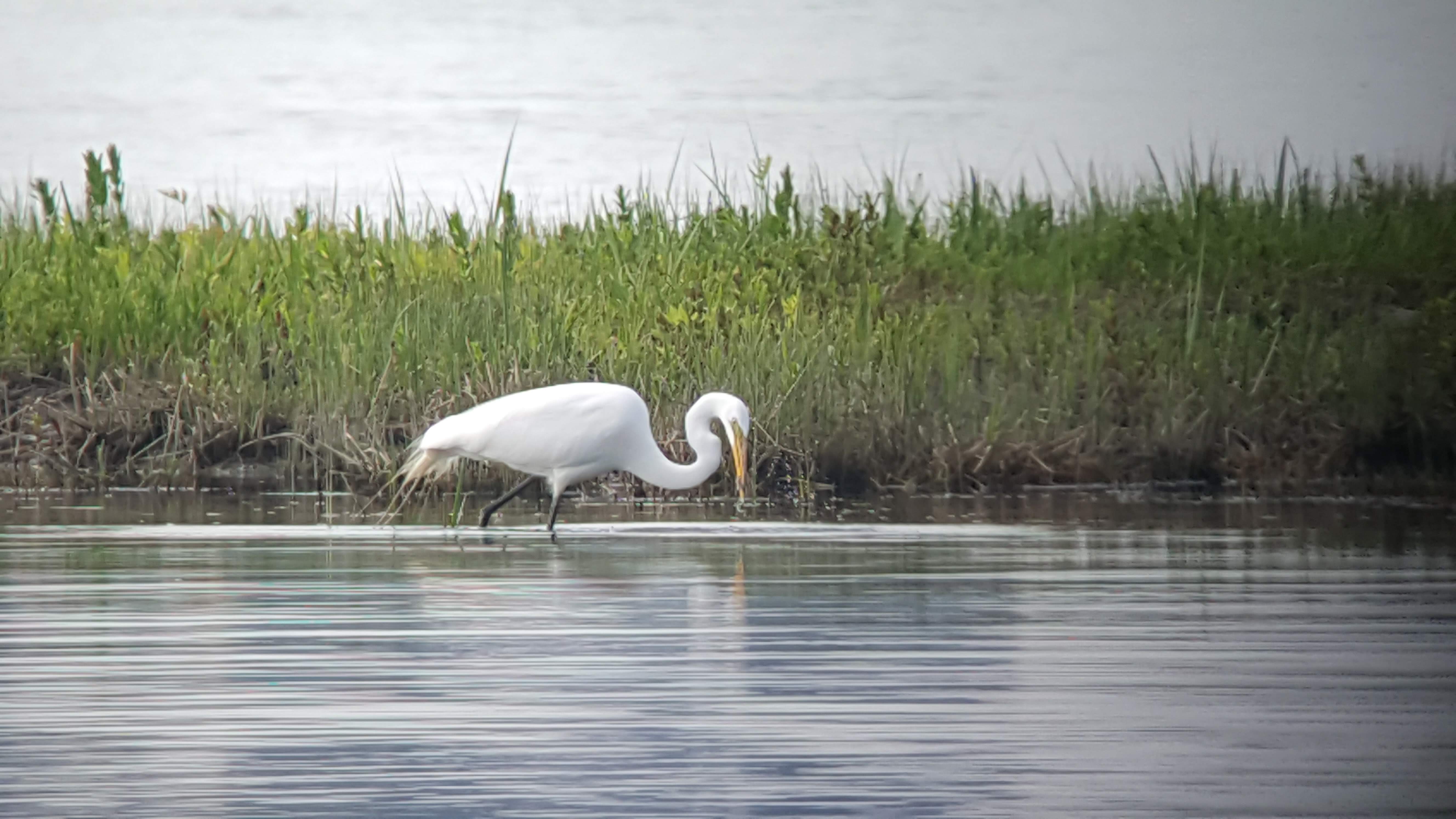
The winds had turned to southerlies on Thursday, bringing in some new species while allowing others to migrate north. A few Robins were already singing as I stepped out the back door onto the deck at 4:10 am. My bike was ready as I saddled up and I rode along the dark streets and bike trails into Gatineau Park. My hope was to hear owls before sunrise. Though that didn’t happen, I did hear an American Woodcock’s courtship flight display in the south end of the Park. Male Woodcocks perform an amazing dusk and pre-dawn flight filled with strange whirring and twittering sounds made by a combination of their voices and wings. As day broke, I quickly added many other species, including an enchanting chorus of Hermit Thrushes – who have, without doubt, one of the most beautiful voices in nature. After an hour of building a good initial list of songbirds, I returned home for a quick breakfast. A Yellow-bellied Flycatcher was a delightful find from my deck as I sipped my coffee. La Foret Chantegrives was quite productive (though fewer species than the day before), with Wood Thrush in good numbers, as well as a few Veerys and a Swainson’s Thrush. I cycled south to the Ottawa River, where I observed several new species including a spectacular Great Egret, many Hooded Mergansers, Tree Swallows, Baltimore Orioles and Warbling Vireos.
Heading east, I encountered the only Common Ravens observed that day. You couldn’t miss them on the bike path which went directly under their conspicuous and foul-smelling nest beneath the Champlain Bridge. At Brebeuf Park, looking onto the Ottawa River where a rapid separates the mainland from a large flat rock, to my delight, I spotted severak Black-belled Plovers, Semipalmated Plovers, Least Sandpipers and an American Pipit.
My last stop along the river was a lookout behind the campus of the Université du Quebec en Outaouais. Atop the limestone cliffs, I had a perfect view of some of the seabird colonies on small islands in the Ottawa River. In addition to hundreds of Ring-billed Gull, Double-crested Cormorants, and a few Black-crowned Night Herons, I found the one “boss” Herring Gull, nesting at the very top of the island. All of the smaller Ring-billed Gulls appeared to be relegated to lower areas, some of which are vulnerable to flooding.
By the time I arrived home before noon, I was up to 83 species. Most birders consider mid-afternoon as the “dead zone” because bird activity such as singing and feeding seems to stop for a few hours. It is tough to find new species at that time. I took advantage by taking a short break to eat, rest and review my list of species to determine what was missing. Late afternoon, I rallied my energy and headed out on a mission to find some of the missing species. It was tough going, but I did find three new birds, two that I had found from my reconnaissance the previous day: Ruby-throated Hummingbird and Chimney Swift, and an Indigo Bunting, always a delight. I ended up with 86 species, three more than the previous year and very satisfying.
Sunday
Two days later, the weather was not as I had hoped. A cold front came in with wind, which makes birding challenging because of the noise created by wind in the leaves. I recognize a high percentage of the birds that I am able to identify by their songs and calls so I was at a disadvantage from the start. Despite the wind, I followed essentially the same route as Thursday, leaving the house shortly after 4 am, and heading into Gatineau Park by bike. My straining ears did detect a faint “peent” call note of a Woodcock at the same place I had the species on Friday. About an hour later, I heard the deep cooing of a Yellow-billed Cuckoo, which was a nice surprise on top of the array of Thrushes and other birds. After about an hour of birding, I returned home for a quick breakfast. There were fewer birds singing, and much more background noise from the trees. I was convinced that birding would be more challenging this day.
A friend joined me for the next several hours, as we biked through la Forest Chantegrives to the Ottawa River, picking up some of the species that I had heard there two days earlier. At the Ottawa River, there was no Egret, but there were several good finds. We spotted a well-hidden American Coot by a beaver lodge on the river, a beautiful Northern Pintail dabbling with some Mallards by the Champlain Bridge, some agile Common Terns fishing on the other side of the River, and a Solitary Sandpiper proving that whoever named the species really got it right. The cold air also brought the Chimney Swifts to the river. Two days earlier, I fought hard to find two swifts. On Sunday, there were hundreds foraging above the River.
When we returned home for lunch I was up to 84 species! At 11h30, I was ready to take a break for lunch, and did this short update video. https://youtu.be/7PkcuzH2wcc
I went solo in the afternoon, walking some of the route I had done by bicycle, again through the Bois des Grives. I worked hard to find a few of the Blackburnian Warblers that breed in the Corridor Champlain, about 1 kilometre from my house as the Raven flies. I watched for nearly 30 minutes on a lookout with a view over the southern hills in Gatineau Park before spotting two Turkey Vultures, that were invisible without binoculars. Turkey Vulture was a species that eluded me on Thursday. The last species observed was from home. I looked to the skies with a glass of wine in hand just as the sun was setting. Three Rough-winged Swallows winged their way northward high above our house, rounding the daily total up to 88 species.
Combined over the two birdathon days, I observed 102 species. There were four species observed during my reconnaissance day that I didn’t find on either birdathon. This knowledge drives my determination (some might say obsession) to find more species the next year. Can I crack the magic 100 species total in one day, within a three km radius of my house before my own faculties give out? Probably not, but I will try, and definitely have fun in so doing.
Thank you for enduring my accounts and especially for your generosity in helping bird conservation in general, and the very deserving Bruce Peninsula Bird Observatory in particular. As I explained in one of the videos, in the past, there was a strong incentive to observe as many species as possible during birdathon, as many people would sponsor me a certain amount per species. Now, that birdathon is organized by an automated donation system that only has a flat rate option, there might appear to be less incentive to work hard to observe birds. I have not given in and softened my approach. I hope you can tell from the account that I do work hard to try and find as many species as possible. I do this because I love it, it is fun, and I want to demonstrate my commitment to this cause. The BPBO Board of Directors, the large BPBO family, and myself are extremely grateful for your support!
Again, here is the link to support my team and BPBO.
Thank you/Merci/Gracias/Obrigado,
Ted
Nous vous serions très reconnaissants de bien vouloir faire un don de bienfaisance pour soutenir le petit mais puissant Bruce Peninsula Bird Observatory – Observatoire d’oiseaux de la péninsule Bruce (BPBO) cette année. Pour la 20e fois environ, je passerai une journée entière à observer autant d’oiseaux que possible afin de recueillir des fonds pour BPBO dans le cadre du Grand Birdathon canadien. En fait, j’en ferai deux fois. La première fois a déjà a eu lieu – c’était hier, vendredi le 21 mai. La deuxième fois – c’est demain, le 23 mai. Cliquez ici pour accéder directement à ma page d’assistance.
Moi, j’habite Gatineau depuis 2006, et je suis active dans le Club des Ornithologues de l’Outaouais. Mais mes efforts sont pour appuyer le Bruce Peninsula Bird Observatory, qui fait du travail formidable sur le suivi des migrations et pour la conservation des oiseaux.
Permettez-moi de vous parler de BPBO (Bruce Peninsula Bird Observatory) l’observatoire d’oiseaux de la péninsule Bruce. Je faisais partie d’un petit groupe des gens qui ont fondé BPBO en 2001, établissant une station de recherche dans la réserve naturelle de Cabot Head du parc de l’Ontario pour suivre les migrations printanières et automnales depuis. L’observatoire a un côté français. Dupuis 15 ans notre gestionnaire de la station est Dr. Stéphane Menu. Stéphane est Français, mais il a fait son doctorat à l’Université de Laval sur les Oies des neiges dans l’arctique canadien. Souvent, il y a des bénévoles pour nous aider avec les suivis, venant du Québec.
BPBO fait face à une autre année extrêmement difficile sur le plan financier. Encore une fois cette année, notre capacité à recueillir des fonds en louant les bâtiments entre les périodes de migrations du printemps et l’automne a été compromise à cause de COVID et aussi parce que la route menant à la station a été endommagée par le niveau très élevé du lac Huron. Pour ajouter l’insulte aux blessures, nous avons récemment appris qu’il n’y a plus de connexion électrique entre notre station et le réseau ontarien et que cette connexion ne sera pas rétablie. Cela signifie que nous devons doubler notre capacité d’énergie solaire pour assurer une source d’énergie fiable (doubler la taille des panneaux et doubler les batteries de stockage). Plus que jamais, le birdathon est devenu une source de financement incontournable. L’an dernier, j’ai soulevé 4 000 $, dont 3 000 $ sont allés à BPBO. Je veux surpasser ce montant cette année, et avec votre généreux soutien, c’est possible.
S’il vous plaît, faites un don à BPBO si vous êtes un partisan régulier de BPBO, si c’est simplement que vous aimez les oiseaux ou le Bruce, ou si vous me connaissez, et combien cela signifie pour moi. J’ai moi-même fait don de 100 $. Ce serait incroyable si vous pouviez égaler mon don et aider BPBO à survivre à une autre année inoubliable.
Laissez-moi vous parler un peu de la journée. Je partagerai un article sur mon birdathon sur mon propre blogue https://birdingfromthebalcony.ca/où cette demande est également publiée. Mon birdathon dure 16 heures, de 4 h à 20 h. Je reste à moins de 3 km de notre nouvelle maison à Gatineau et je voyage uniquement à pied ou à vélo. L’année dernière, j’ai observé 83 espèces les deux jours. Hier j’ai observé 86 espèces. Mon objectif demain est d’atteindre ou de surpasser ce total.
Aidez-moi à soulever 5 000 $ pour la conservation des oiseaux. Nous pouvons y arriver, mais uniquement avec votre généreux soutien. Oiseaux Canada vous émettra un reçu d’impôt pour les dons de plus de 15 $.
S’il vous plaît, donnez généreusement à mon birdathon pour BPBO cette année. Utilisez ce lien pour accéder à la page de don: https://www.canadahelps.org/s/FjNst
Je fournirai des mises à jour en direct de mes progrès sur mes pages Facebook et Instagram.
Merci d’avance!
Ted
Dear Friend,
We would be so grateful if you would make a charitable donation to support the small but mighty Bruce Peninsula Bird Observatory (BPBO) this year. For the 20th or so time, I will be spending an entire day observing as many birds as possible to raise funds for BPBO through the Great Canadian Birdathon. In fact, I will do birdathon twice – first during the week of May 17 and secondly on either Sunday or Monday of the Victoria Day weekend a few days later. Click here to go directly to my support page.
Let me tell you about Bruce Peninsula Bird Observatory. A few of us who loved the upper Bruce and especially the Cabot Head area, founded BPBO in 2001, establishing a research station on Ontario Park’s Cabot Head Nature Reserve to track the spring and fall migrations ever since. BPBO is facing another extremely tough year financially. Again this year, our ability to raise funds through the rental of our research station property between spring and fall has been compromised because of Covid, and the damaged road to the station. To add insult to injury, we recently learned that there is no longer an electrical connection from Cabot Head to the Ontario grid, and that that connection will not be re-established. That means we must double our solar energy capacity to assure a reliable energy source (doubling the size of the panels and doubling the storage batteries). More than ever, birdathon has become a key source of funding. Last year, your support enabled me to raise $4000, of which over $3000 went to BPBO. I want to surpass that amount this year, and with your generous support, that is possible.
Please donate to BPBO if you are a regular BPBO supporter, if you just love birds or the Bruce, or if you know me, and how much this means to me. I donated $100 myself. It would be amazing if you could match my donation and help BPBO survive another unforgettable year.
Let me tell you a bit about the day. I will share a post about my birdathon on my own blog https://birdingfromthebalcony.ca/ where this request is also posted. My birdathon is 18 hours long, from 4 am to 10 pm. I stay within 3 km of our new house in Gatineau and only travel by foot or bicycle. Last year I observed 83 species both days. My goal is to meet or surpass this total this year.
My goal is ambitious – to raise $5,000 total, of which $4,000 will flow to BPBO. We can get there but only with your generous support. Birds Canada will issue you a tax receipt for donations over $15.
Please give generously to my birdathon for BPBO this year. Use this link to get to the donation page: https://www.canadahelps.org/s/FjNst
I will provide live updates on my progress on my Facebook and Instagram pages.
Thank you in advance!

Ted
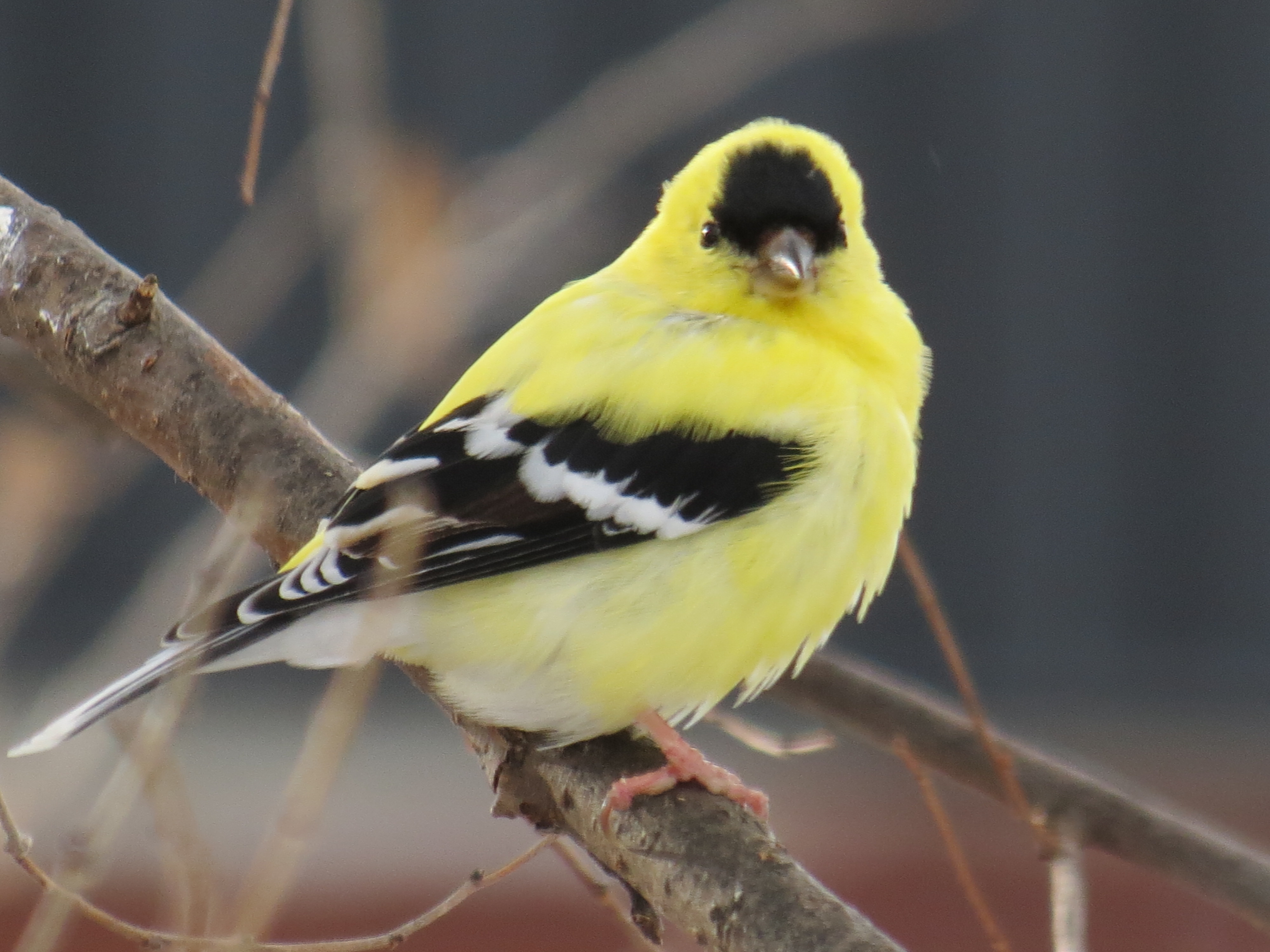
Fittingly, the first bird species I observed on January 4, the day we took possession of our new house, was an American Goldfinch. We now live on rue des Chardonnerets, (Goldfinch in French). If you read some earlier post you will be familiar with Golden Goldie, and understand the significance.
We moved gradually over the month, not passing our first night in the new house until January 31, the date when we had to be out of the old apartment, where we lived for the past 10 years, and the location of Birding from the Balcony. Our new house was in very good condition when we purchased it, but there were still minor renovations to do that take time. For example, removing a wall, no matter how small, triggers work to fix ceilings and floors. Removing a “popcorn” ceiling can, and did, lead to re-plastering an entire new ceiling. Several rooms needed painting, and then there was that strange drainage pipe from the air conditioner, hanging limply on my new office wall. I had to hide it.
So, the only birding in January was done while travelling five metres from the car to the front door with loaded arms, and February was not much better as the renovations continued for most of the month. Now we are in April, and I am finally taking advantage of the wonderful deck and backyard, where I can contemplate how true it is that work on a house never ends while trying to listen and watch for birds.
First a deserved ode to our Boucherville apartment. It was such a good location for birding. Over the 10 years of tenancy I observed 151 species from inside or on the balcony. As for the “big year yard list,” I am certain that I will never get close to the number of species I observed while Birding from the Balcony on Boucherville, in 2020. One hundred and twelve species is an impressive number for one year, but it was an incredible location under perfect circumstance. I say that fully aware that the pandemic made a major contribution to what I am calling perfect circumstances.
In reviewing my bird list from 2020, I noted about 20 species that I have little to no chance of observing from the new address. This was the effect of the Ottawa River. From our apartment, especially the balcony, there were vantage points to see birds flying above the Ottawa River (about 700 metres away). These included waterfowl, gulls, cormorants, herons, swallows and some raptors that follow the river like Osprey and Bald Eagle. I could see this all from my perch on the balcony with my binoculars or my 20 X 60 scope aimed at one of the two openings in the trees and buildings where I could see a section of sky just above the river. Then there was that narrow strip of Gatineau Park on opposite (east) side of the house from the balcony, with enough height to be at canopy level, offering a perfect view of migrating warblers and other songbirds moving through the treetops. On the north side were our neighbour’s four tall white spruce trees that acted like magnets to warblers, nuthatches and finches. Windows on all four sides of the house let in the sound, meaning that many times I was able to identify birds inside the house by hearing their songs.
Last year I had more time to bird as I worked at home from most of the year due to the Pandemic, which also made the city much quieter, especially in the spring when much of Canada was locked-down. The species exemplifying how quiet the city was for me, is American Woodcock. Woodcocks were displaying about 400 m. from our balcony and I was able to hear the twittering of the courtship flight on two different occasions! All of these factors combined to make last year exceptionally good for observing birds from our apartment.
Our new house has no balcony, but it does have a yard and a deck. The river is 1.3 km away with a forest between the river and us. Our house is within 75 metres of the forest edge. The many mature trees between houses make our yards a functional extension of the forest for bird species. I expect the forest bird observations will be good here!
One of the first things I did in our yard to attract birds was to install feeders. It took a few days after filling sunflower, suet, nyger and peanut feeders, but eventually the local band of Chickadees discovered the sunflower seeds and the Blue Jays discovered the peanuts. Cris loves the jays. One day, a bit before her birthday, but maybe as an early present to her, the Jays held a wild party for the party she couldn’t have due to Covid-19. We were blown away.
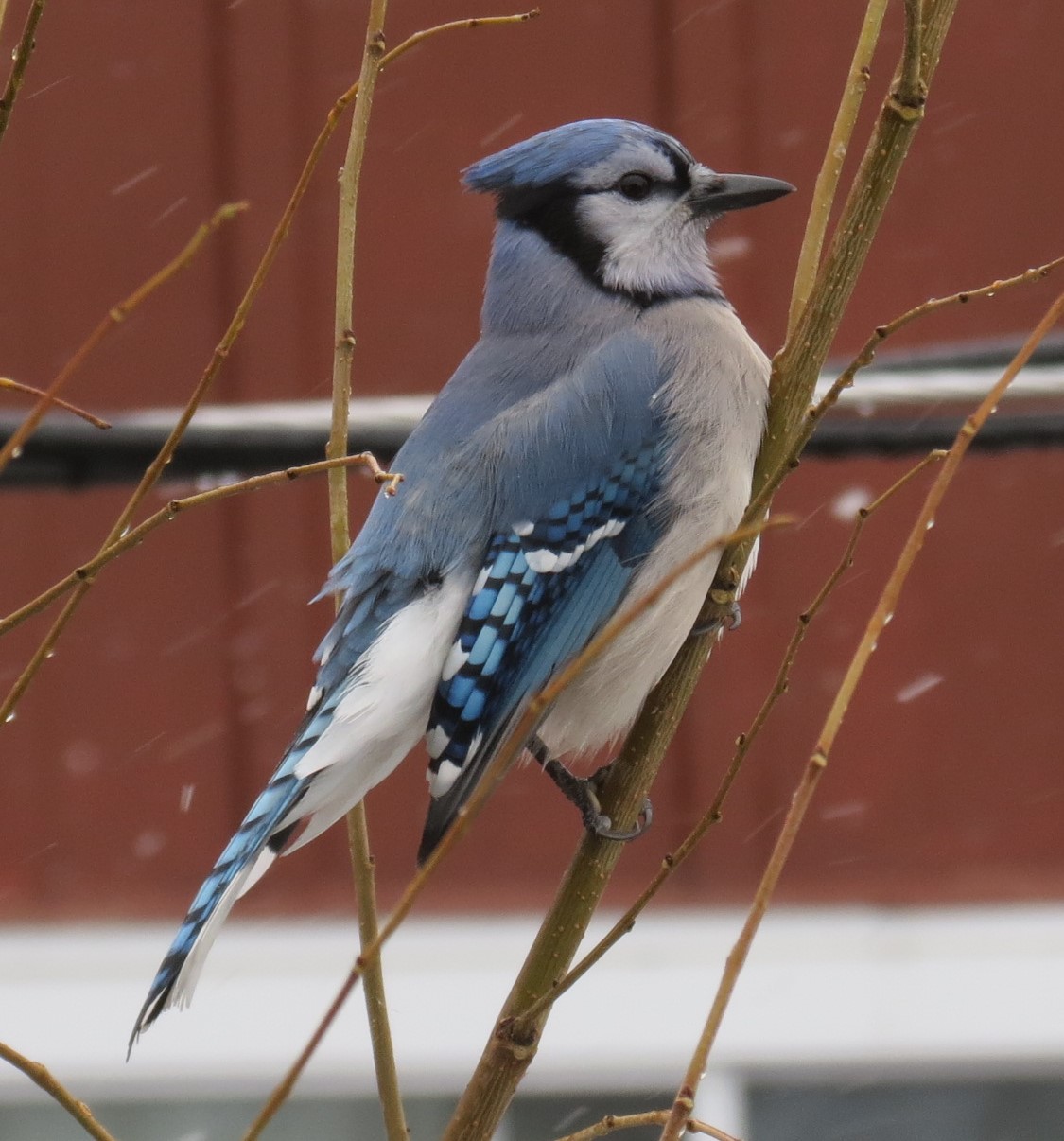
Ten days after the feeders were installed, the Eastern Gray Squirrels discovered them. My ‘system’ to discourage squirrels turned out to be a joke for them, not delaying access to the feeders by a second. After fruitless attempts to discourage and chase them away, and their increasing habit of knocking down the suet, peanut and sunflower feeders, we gave up on all but the Nyger feeder that didn’t interest them. Unfortunately, the Nyger feeder has not interested anyone, as even the local flocks of Goldfinches and Redpolls have snubbed us.
Fortunately the Jays and us have figured it out. I put a handful of nuts out early in the morning, then call the Jays with my Sibley app. They appear within a minute or two and empty the feeder before the squirrels have wiped the sleep from their eyes. It’s working like a charm to the delight of the new residents of this house.
We are working to keep the cats out of our yard. The previous owners had two outdoor cats that likely terrorized the local birds. These cats likely attracted other cats into the yard. I am trying to change our yard from cat central to no go zone for cats. We put up a snow fence in early February across the back of the property, to make it tougher for cats travelling through the yard to have easy egress and ingress. It definitely helped. I’ve also chased a few cats and placed an ultrasonic “cat deterrent” in a strategic location. All of this has reduced visits significantly, but there is much work to do.
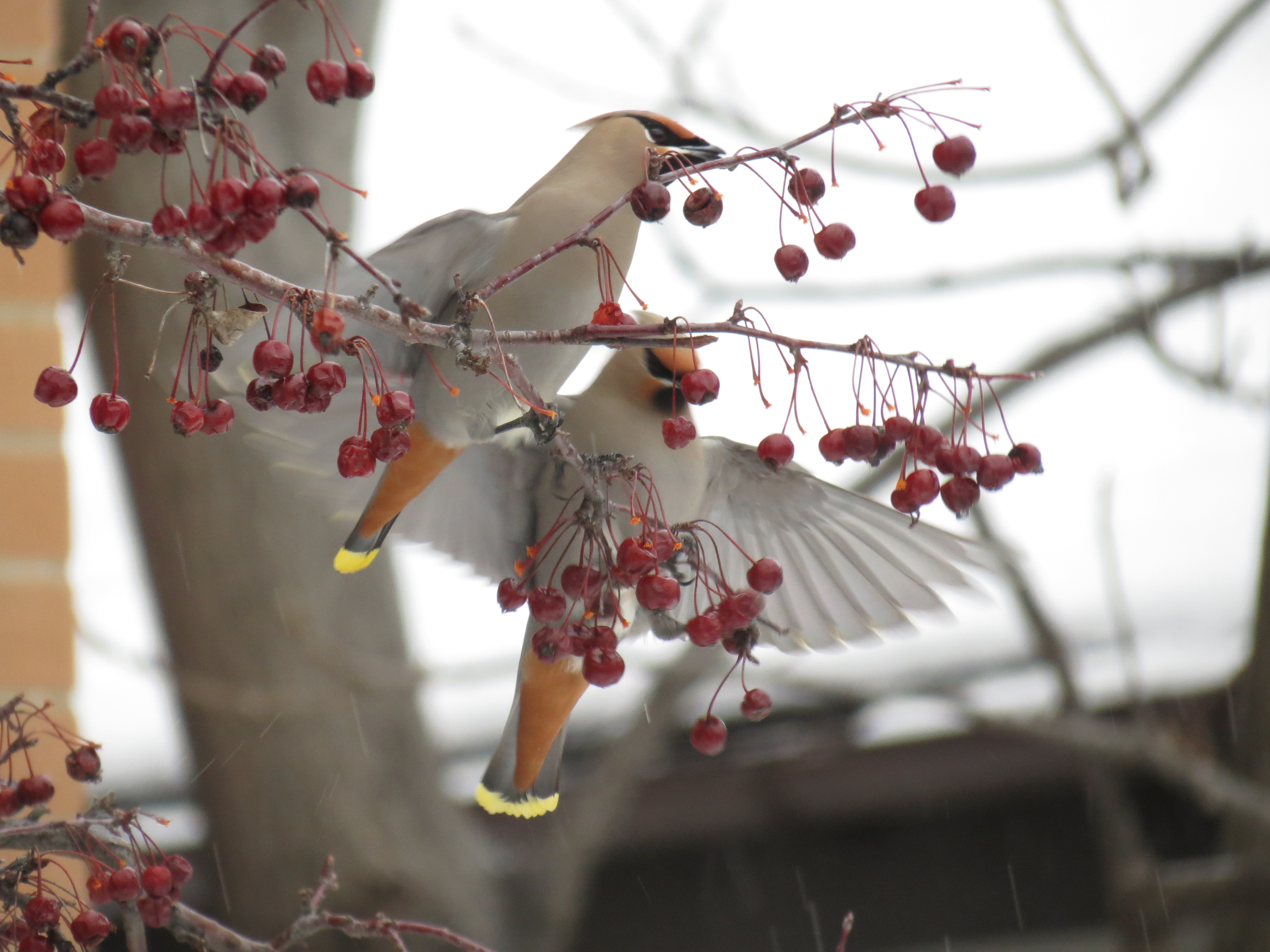
There have been few bird “highlights” so far. But I have enjoyed many flocks of Bohemian Waxwings and a few groups of Cedar Waxwings flying over or landing in the tree in our yard. Redpolls have been around the neighbourhood since we moved in, and one day some Red Crossbills flew over the house. In March, the first early spring migrants started showing up around the 13th with a bigger push after the 21st – the official first day of spring. That day and the 23rd, I observed the first Canada Geese, Ring-billed Gulls, Common Grackles and Song Sparrows. By the end of March I had observed just over 30 species for the year. Now, over half way through April, I am at 40 species.
One characteristic of our subdivision is that most of the streets have bird names (en Français). In addition to Chardonneret, there is Paruline, Gaie bleue, Sitelle, Mésange, Tourterelle, Huard, Perdrix, Cormorant, Bruant, Pinson, Colibri, Carouge, Épervier, Cygne and Heron. If ever a neighbourhood should become bird friendly, it is this one!
The neighbourhood or “sector” as it is called in Québec, is “Manoir des Trembles” which would be translated as Poplar manor, but for some reason is called Birch manor on some maps. Avenue des Trembles is one of the main streets crossing through the subdivision. Our street connects with it, but on the opposite side of Trembles is Rue Épervier. An Epervier is an accipiter – the small family of hawks that specialize in catching birds. In late February, as I stepped out of the car around 5:30 pm, just as it was getting dark, I noticed a lump in a tree at the junction of Épervier and Trembles. Of course, it was an Épervier brun – Sharp-shinned Hawk. Who ever named these streets, knows lots about birds!
 This is my final summary of many years of birding from the balcony, and inside our lovely apartment. In fact, I’ve been living in this house for nearly 15 years, over 10 from our current top floor apartment. As described before, this apartment lends itself to birding with its east-facing windows that open onto a canopy-level extension of Gatineau Park forest. The west-facing balcony, in front of a very bird-friendly clump of Manitoba Maples and Japanese Elms, has a clear view to the north and to the south. It also has an array of bird feeders and water containers. The kitchen window on the north (I spend lots of time in the kitchen cooking), faces our neighbours’ four mighty spruce trees. From the balcony, when I look south, I can see over the Ottawa River, about 600 metres away, behind l’Université de Québec en Outaouais campus and a cemetery. Although trees and a few buildings obscure the river, I have spotted many different species of birds flying above the river that I would otherwise not have observed, including all of the swallow species, and many species of waterfowl and raptors, which migrate along the river corridor.
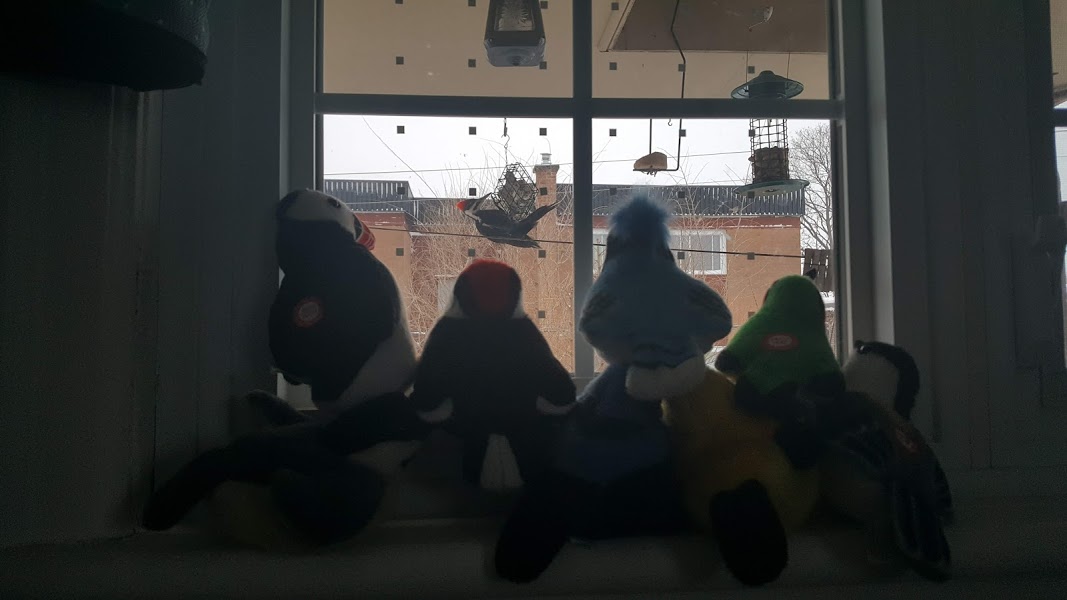
The gang piles on to enjoy watching the big pileated whacking the suet
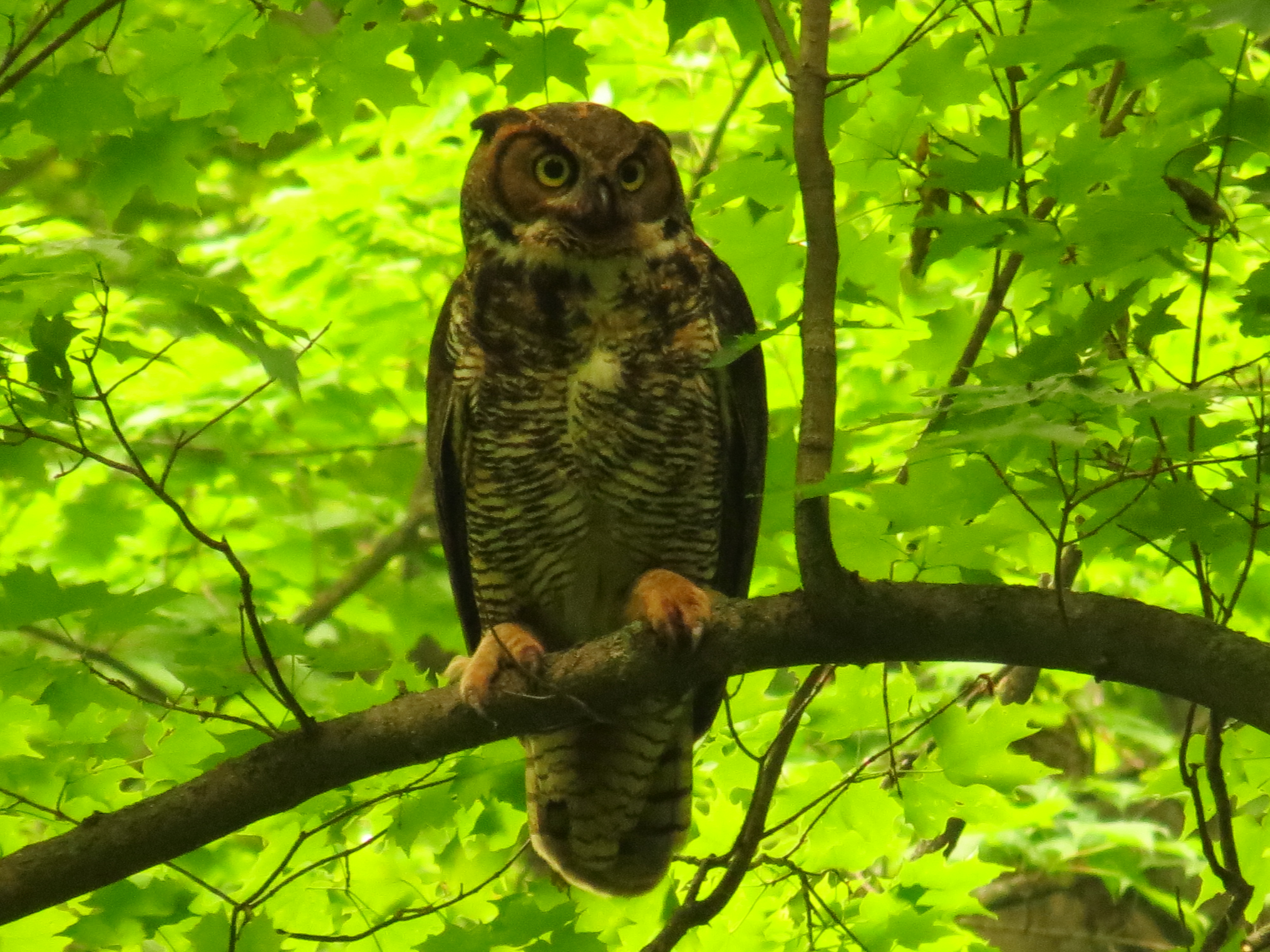
Great Horned Owl
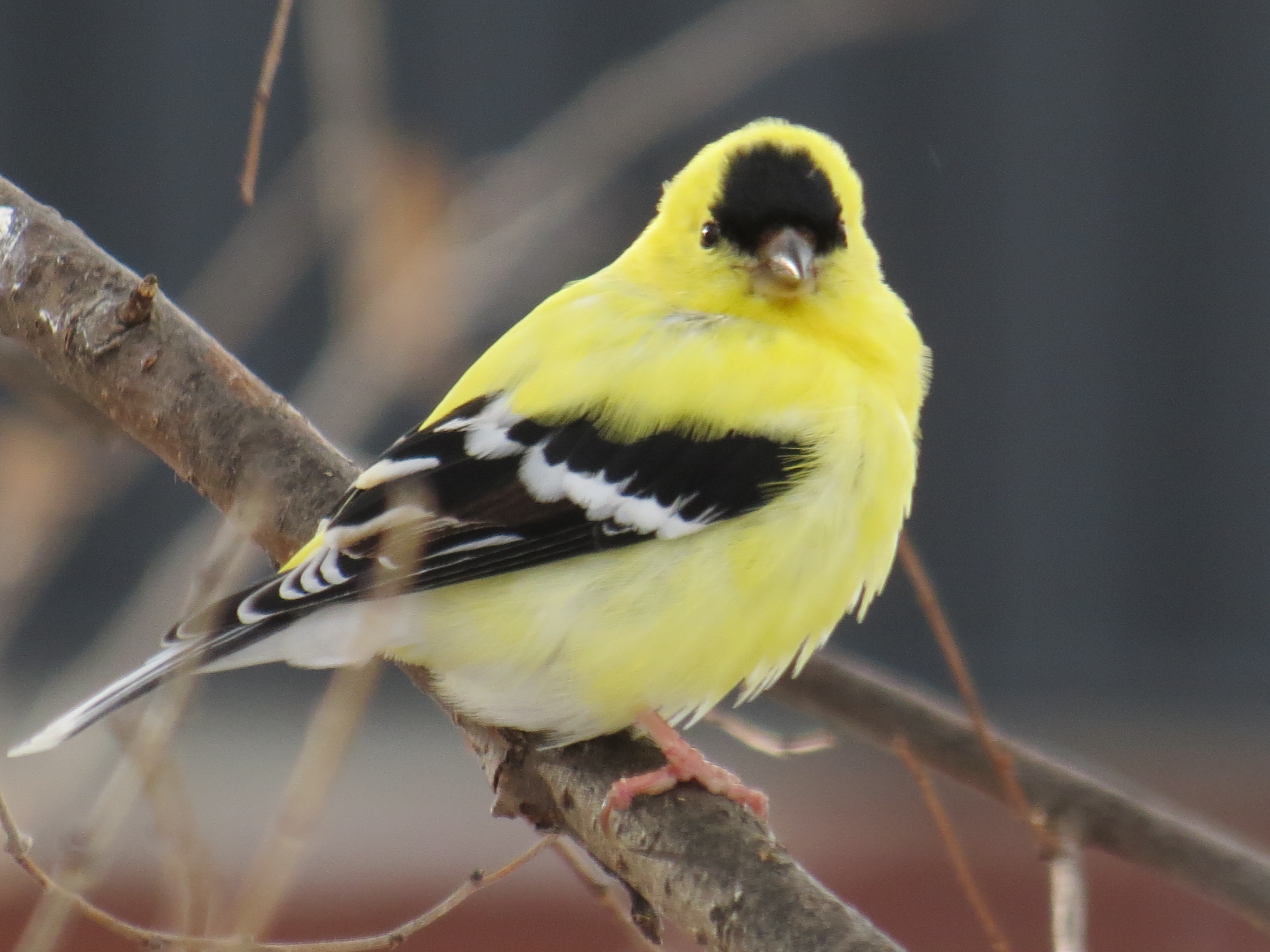
Golden Goldie
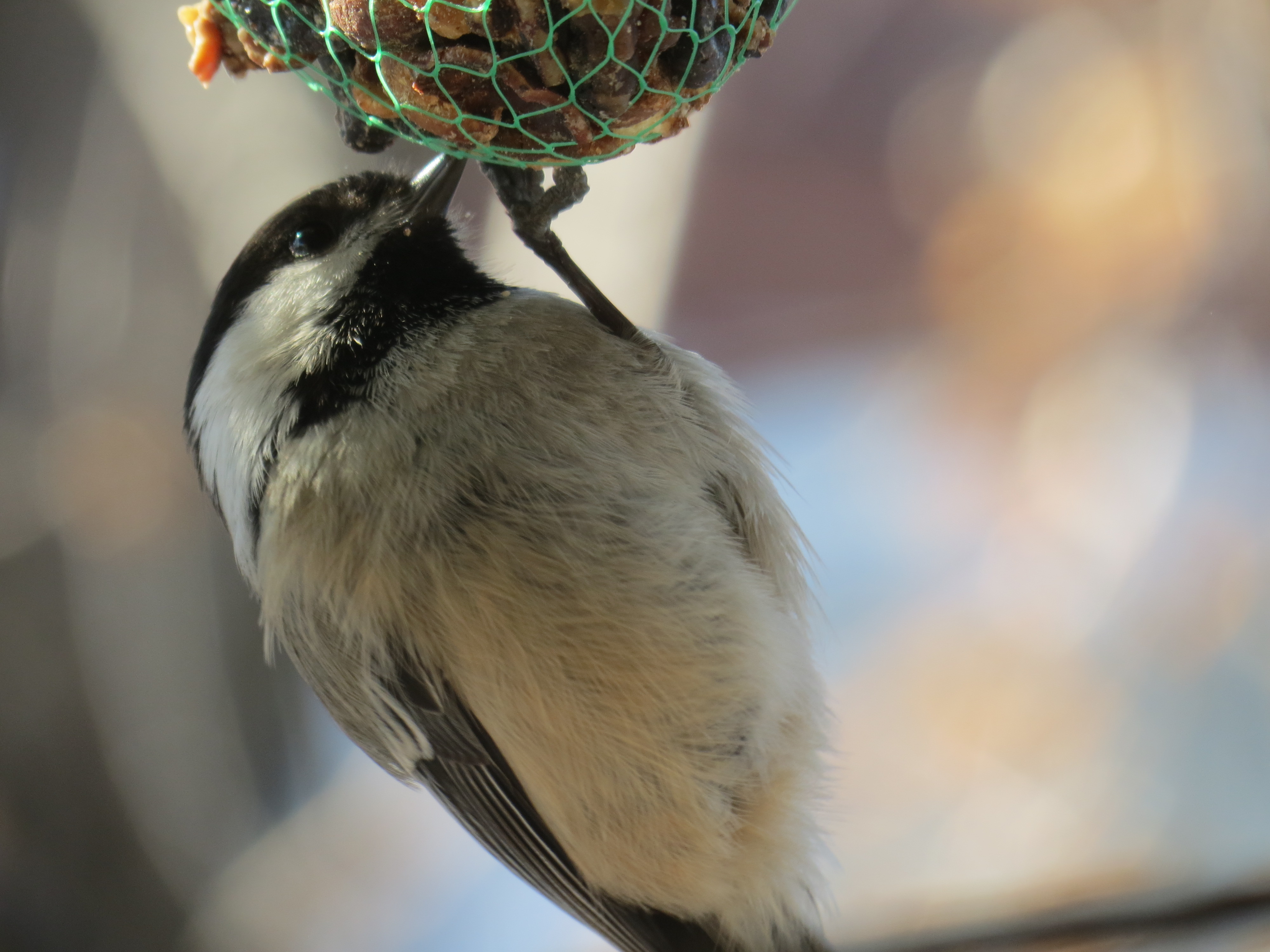
Peggy the Chickadee
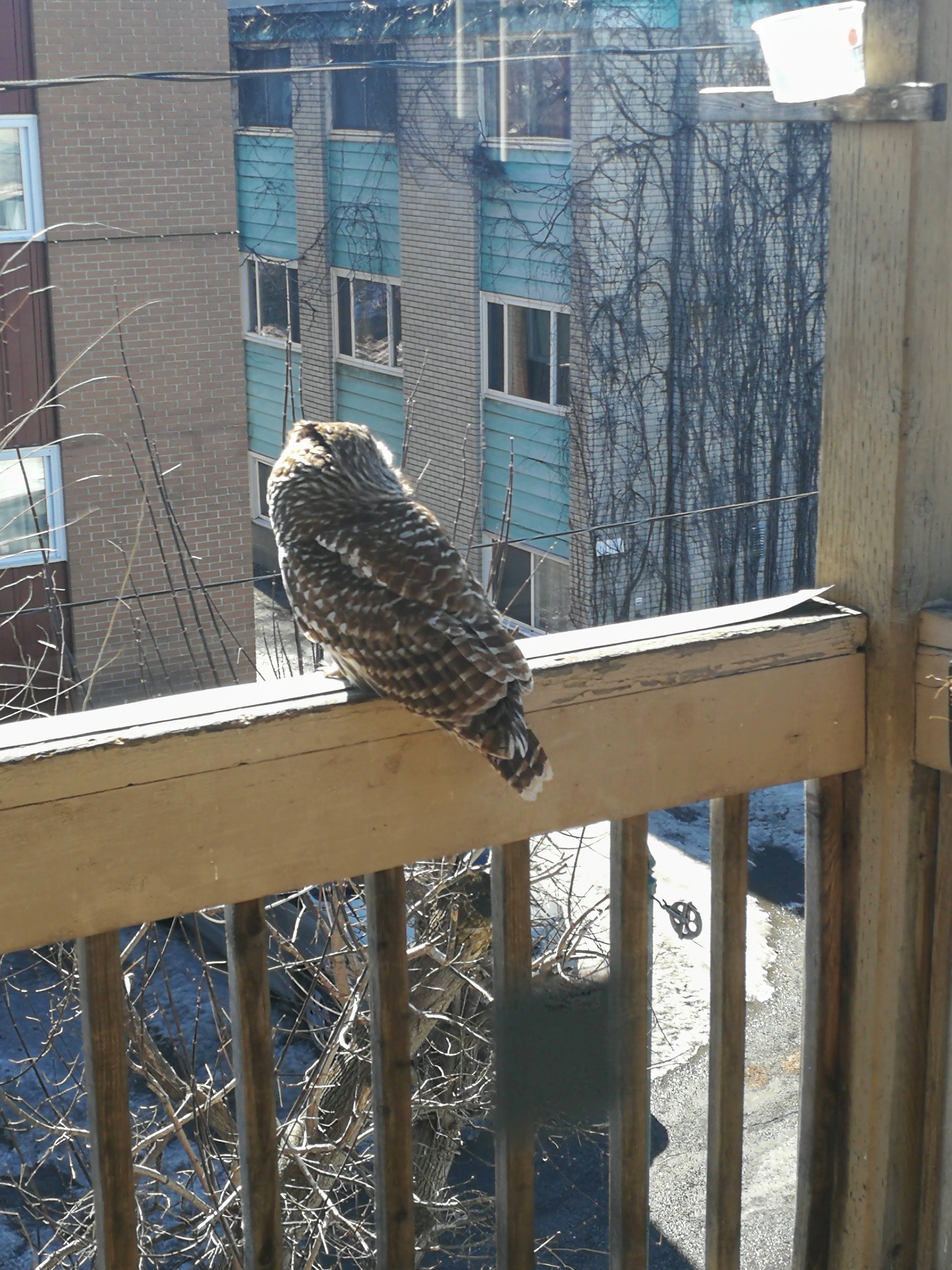
Barred Owl visits Cris
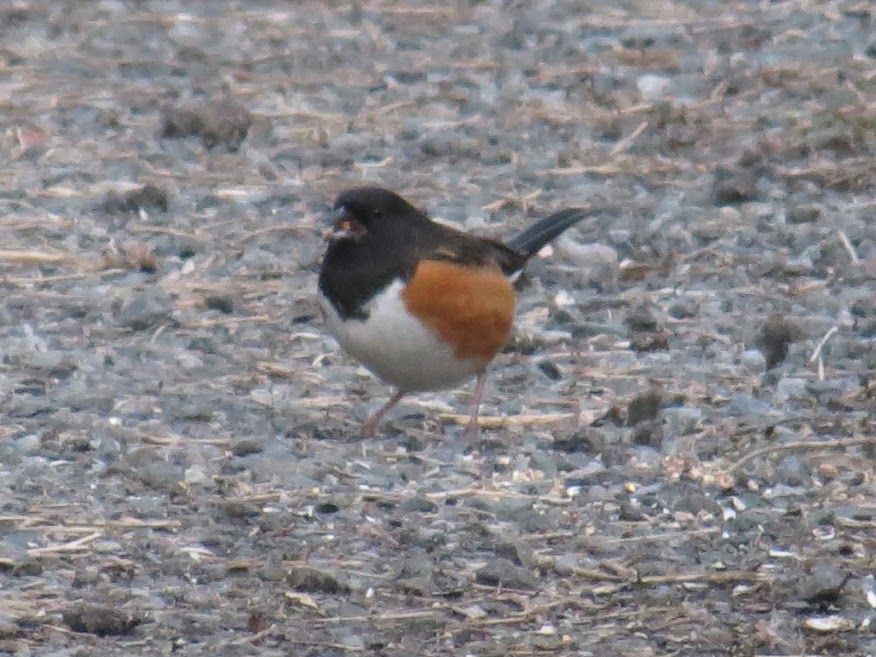
Eastern Towhee
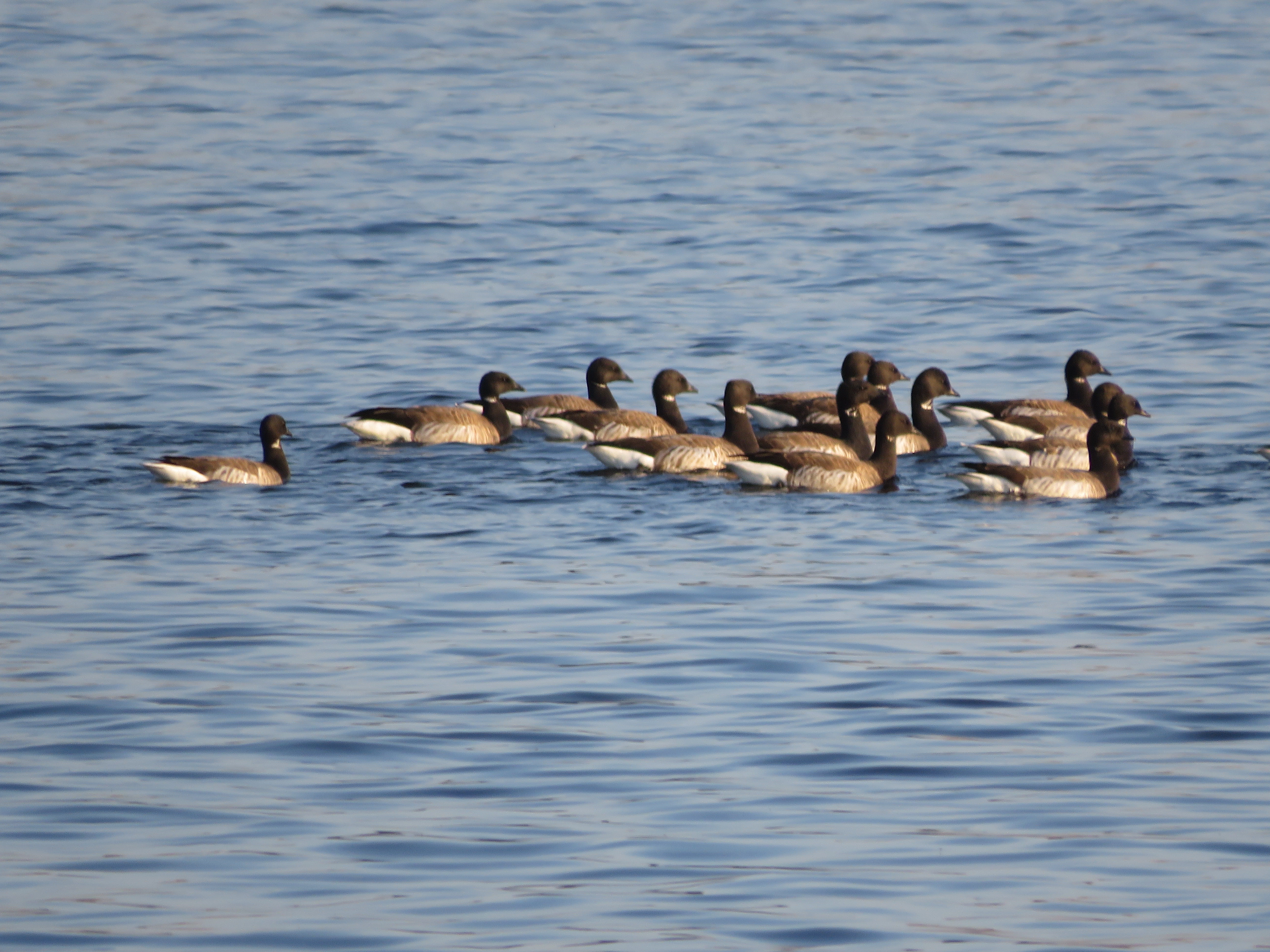
Brant Geese on Ottawa River
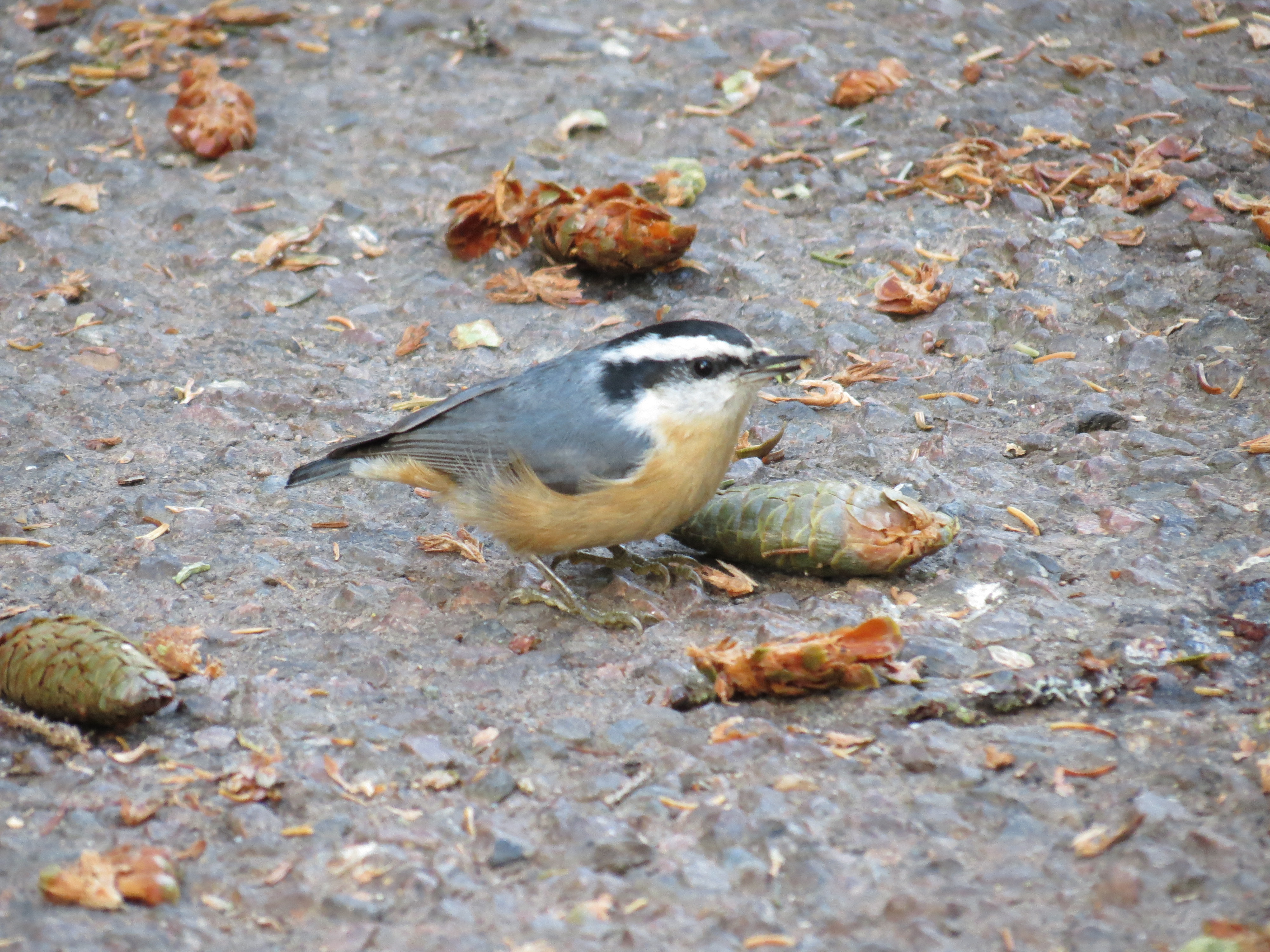
Red-breasted Nuthatch
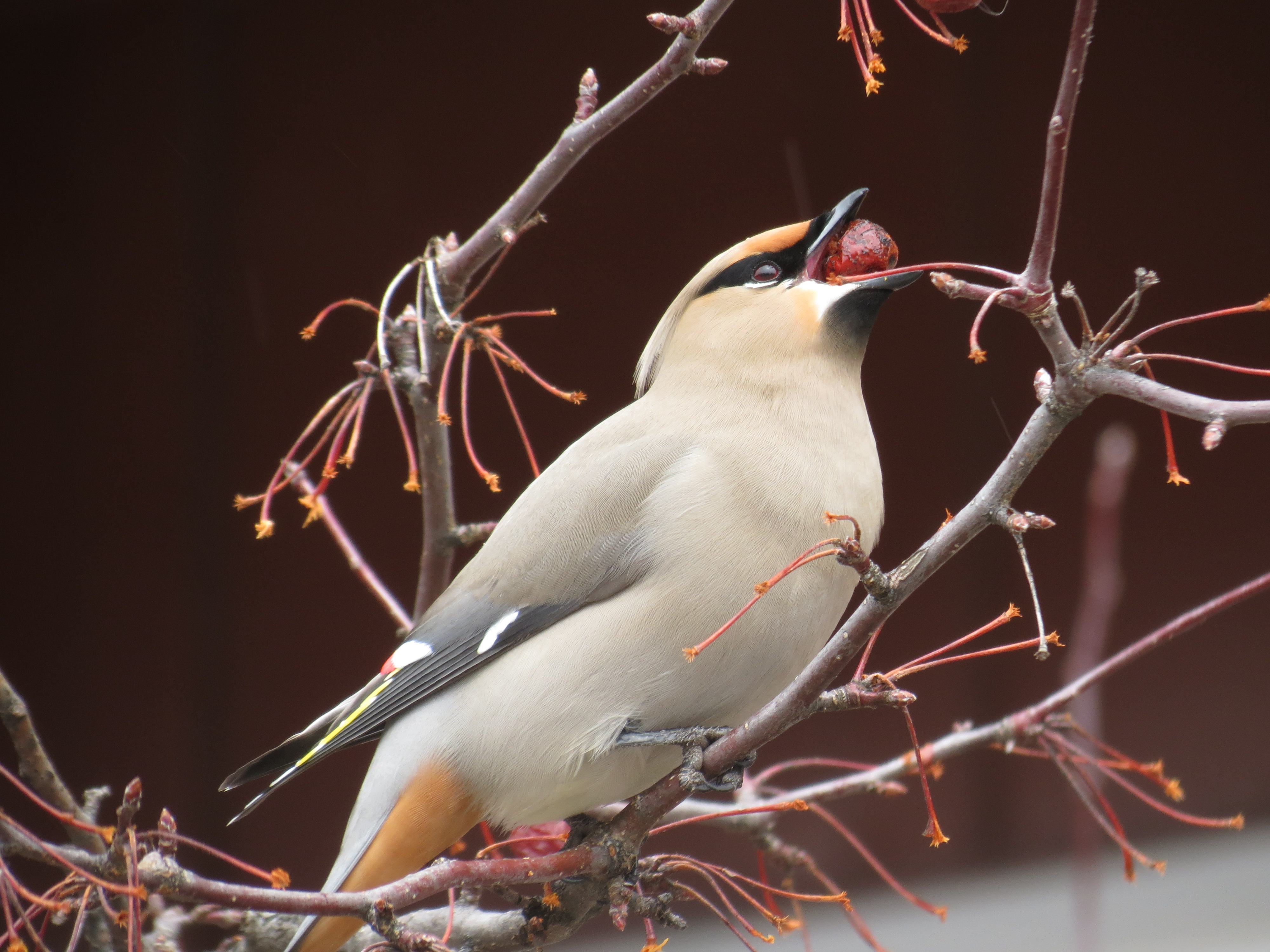
Bohemian Waxwing
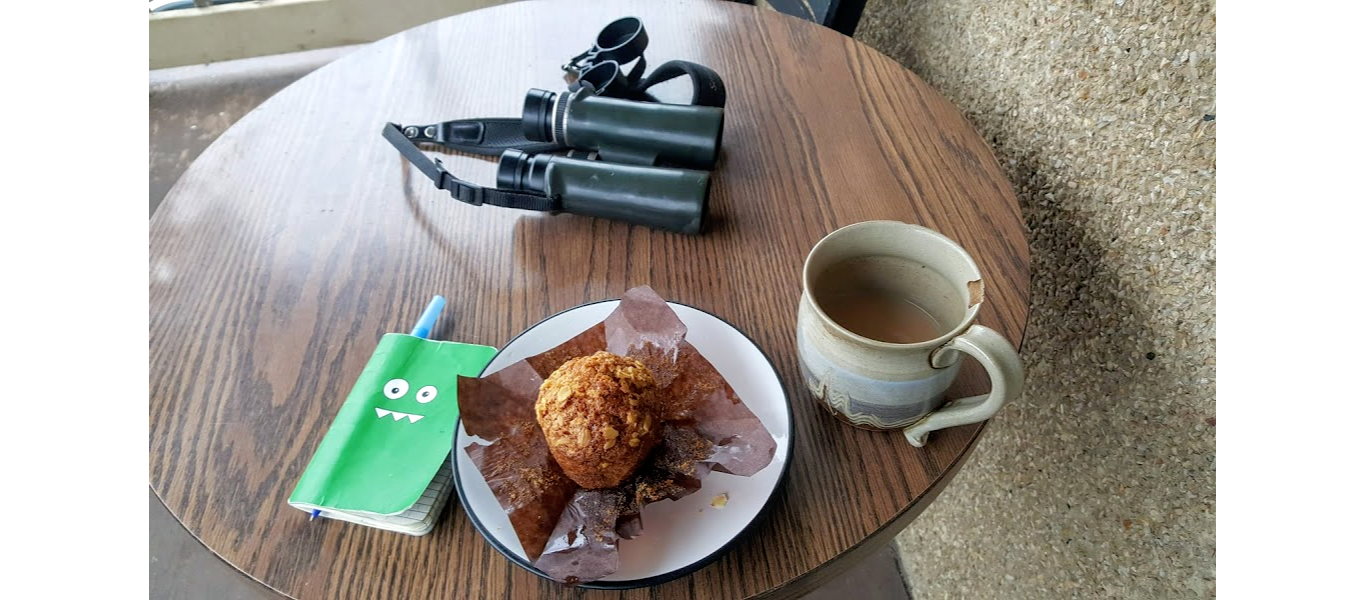
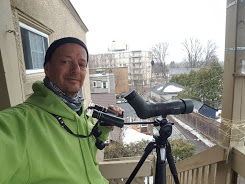
My ‘equipment’ for early morning birding from the balcony
After cycling 54 kilometres from Saint Faustin du Caré to the Mont Tremblant Village and back on Thursday, I was ready for a restful Friday morning with reading time in the hammock and a cool swim before heading home. That was until Cris talked me into going birding. “Don’t you want to find the Bicknell’s Thrush on le Carcan?” she implored over dinner on Thursday evening. That was all I needed to hear. Cris had been with me on several occasions when I had failed to find a Bicknell’s Thrush, including one earlier in the week at Mont Johansen in the Park. Friday was our last of five days in Parc national du Mont Tremblant and the last opportunity to try and find this elusive species. My history with the species was one of failure, so what would be different this time? “You’ll get your bird this time” she said confidently. I wasn’t so confident.
Bicknell’s Thrush is a Threatened songbird that lives on the mountaintops of northeastern North America. Most of its range is in Quebec where it occurs in dense stunted spruce forests, mainly above 700 metres away from the Atlantic coast. Bicknell’s Thrush migrates to the Greater Antilles, overwintering on high elevations in Cuba, Hispaniola, and Puerto Rico. Extreme deforestation on the wintering grounds, climate change, and habitat loss on the mountaintops on the breeding grounds is threatening the species’ survival.
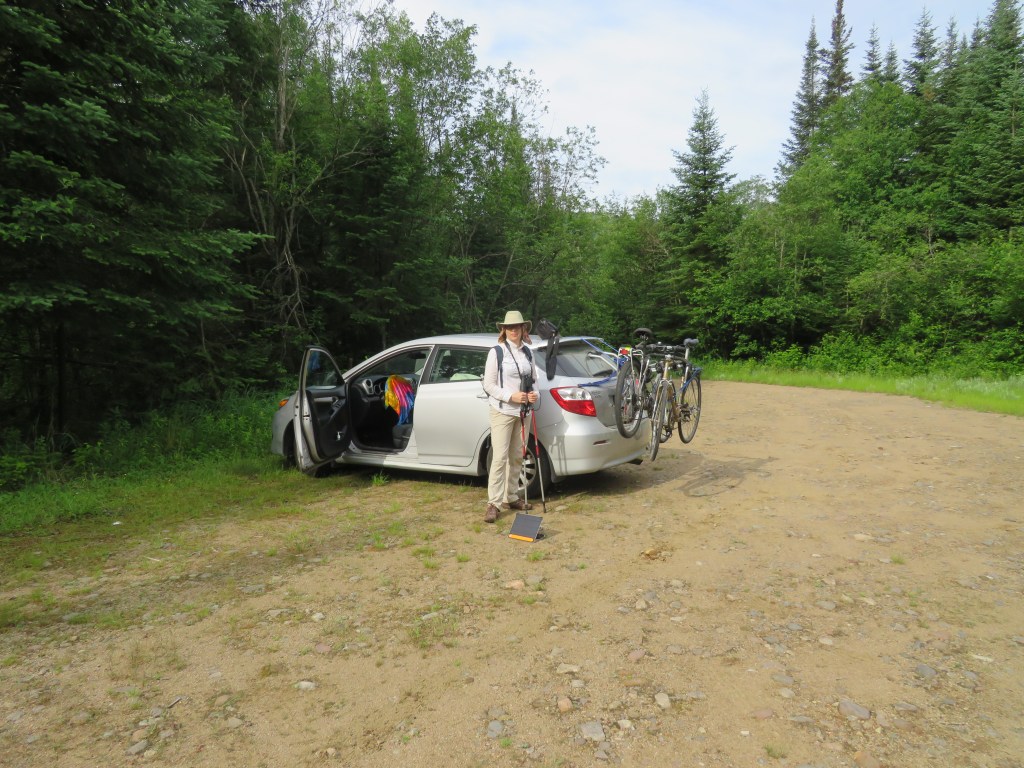
Next morning I was up making coffee at 5H30 and we broke camp by 7 am, but didn’t reach the Carcan Trail Head until 8:30. The road to the trailhead was rough. Hoards of hungry mosquitos awaited us in the parking lot, along with a sign stating that the trail had received no maintenance for over a year. The Carcan Trail is a 14 km round trip hike with a vertical climb of 530 metres. At 883 metres above sea level, Le Carcan is the second highest peak in the expansive Parc national du Mont Tremblant and one with historical records of this rare thrush, the only regularly occurring songbird in Eastern Canada that I have not observed. I was cautiously optimistic. Even with no Thrush, the hike would be a good physical challenge and worth it.
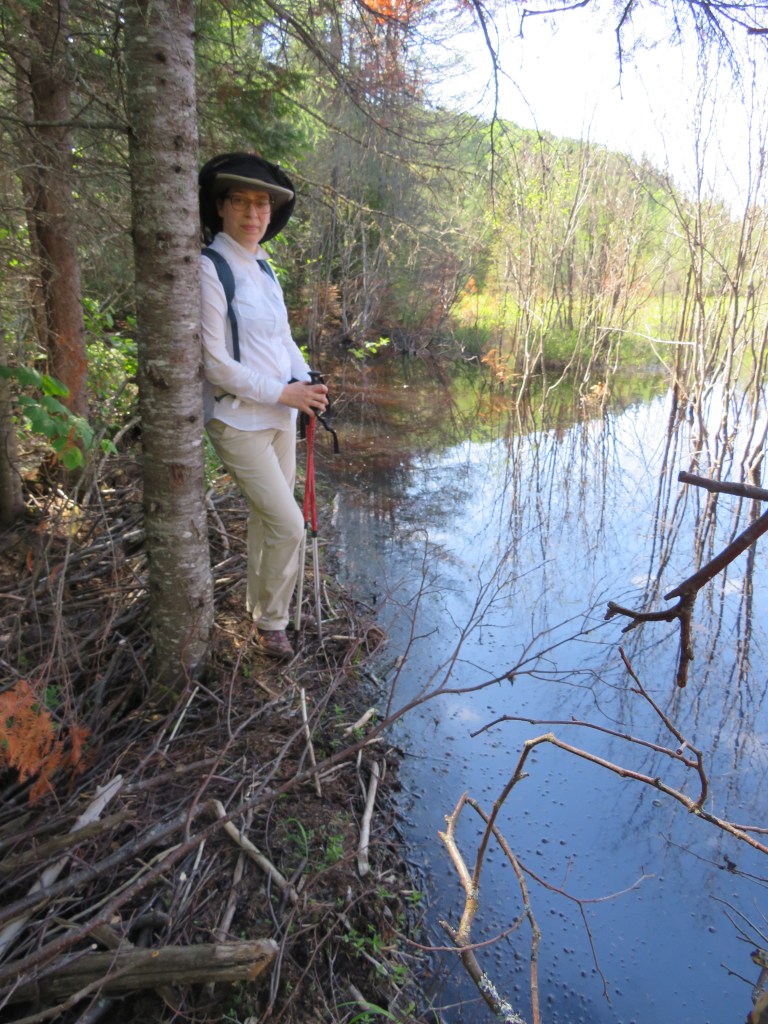
The trail was indeed a challenge. The first 1.5 kilometres followed an old logging road. That’s where we encountered the first trees across the trail. Once the trail left the logging road, the first real test came. The path led straight into a small lake, emerging about 30 metres beyond. It was not clear how we could cross this without getting very wet. However, a bit of off trail exploring led to the beaver dam that had caused the flood. We had to cross about 30 metres of dam to get to dryer land on the other side, then work our way through the forest to find the trail. Once back on the trail, we continued through maple and birch lowlands, before starting up the base of the mountain. The trail meandered along, adjacent to a tumbling stream with attractive waterfalls. The bird community was vibrant and the air full of song, dominated by the uniquitous Swainson’s Thrush (close cousin of the Bicknell’s Thrush). There were also Veerys, Hermit Thrushes, White-throated Sparrows, Winter Wrens, and several warbler species including Black-throated Green, Black-throated Blue, Northern Parula, American Redstart, Black and White, Chestnut-sided, Blackburnian, Ovenbird, and Yellow-rumped. Yellow-bellied Sapsuckers, Red-breasted Nuthatches, and Blue-headed Vireo were also common.
At times, it was challenging to locate the trail, which was often blocked by fallen trees. As we climbed, the forest changed from mixed hardwoods and conifers to spruce and fir conifer forest. I encountered the first ‘boreal’ species of bird just after kilometre 4 – a stunning Black-backed Woodpecker. Shortly after, a family of Boreal Chickadees announced their presence with their wheezy “sick a djee” calls, along with a Pine Siskin.
Around the 5 km mark, we spotted a Spruce Grouse displaying on the side of the trail. Just beyond was its brood of at least four Spruce Grouse chicks. These were all somewhat unexpected boreal species that I was delighted to observe! With a kilometre to go, the trail was nearing the summit and the forest was noticeably shorter and denser, and dominated by spruce. Though I had never observed a Bicknell’s Thrush in its breeding habitat, I knew that we were in the right place, and with a bit of luck, we might be rewarded.
Finally we reached the top, where there was an exposed rock area to sit for lunch and take in the view. Swainson’s Thrushes were still present, without doubt the most numerous species throughout the trail. There were also a few other species singing, including Magnolia, Nashville, and Yellow-rumped Warblers. It was about noon by this time and the bird song level had subsided.
While at the summit, we were joined by two other hikers with whom we shared our experiences and thoughts about the trail. During this conversation I heard a call note that caused me to pause and to excuse myself from the conversation. I walked a few metres to get a better view into the dense forest of where the sound was coming from. I was extremely excited as I was certain the call was from a Bicknell’s Thrush. The call note was emphatic and high-pitched with a definite descending tone, completely different from the call note of the Swainson’s Thrush, which ascends. The call came from the dense stunted spruce forest in front of us. The bird called frequently, and after a minute or two, to my delight, it burst into song, a distinctive descending fluted song. I pulled out my phone to listen to the Bicknell’s Thrush song on my Sibley app. Sure enough the singing bird was confirmed. I then pished and watched, and the bird responded by flying past, through the Spruce trees in front of me. I was able to see its rich reddish-brown back as it flew by twice. It continued singing as I soaked up this wonderful moment. Eventually I settled back down with the others, excusing myself for leaving the conversation. The other two hikers were fascinated by both me and the bird. I looked up and noticed two Turkey Vultures soaring over the summit with a raven-sized raptor aggressively driving them away. The powerful bird was my favourite bird of prey, a Northern Goshawk! Goshawk is the epitome of power. Years can pass for me without seeing one. When I do, I get goosebumps. I had goshawk goosebumps on my Bicknell’s thrush goosebumps!
I finally sat down to finish my lunch, thinking how the hike was so worth the effort and how grateful I was of Cris for supporting my birding passion and for encouraging the hike. At that moment the beautiful notes of a Fox Sparrow’s song registered in my head. It may have been singing for a while without me noticing because of the Bicknell’s and the Goshawk. I had not even realized that Fox Sparrow bred in Mont Tremblant Park, as it is really a northern boreal forest species, so this was a wonderful surprise. We were able to get excellent views of this top-notch singer, named because of its beautiful rusty plumage.
Birding trips and hiking trips can be disappointing if we set our expectations too high. For the Carcan hike, I was hopeful, but without high expectations. On every front, both Cris and I were delighted and exhilated by the birds, the hike, and the nature. The Carcan trail is one of the best birding/hiking trips that I’ve done in Canada.
This post describes how I spent May 25th, 2020. I did what is called a “big day” in the birding world, as part of a fundraising event organized by Birds Canada called the Great Canadian Birdathon. The idea is to raise money for a good cause by trying the find as many bird species as you can in one day. Birds Canada allows birdathon participants to dedicate most of the funds raised to a nature charity of choice. My choice is the Bruce Peninsula Bird Observatory (BPBO), an organization that I co-founded in 2001. You can read about this history in my previous blog post. Now birdathon has its own rules, the main of which is to only count bird species that you are absolutely certain of observing. The rest is flexible, so my two birdathons had simple rules: stay within an approximate 3 kilometre perimeter of our apartment, travel only by foot or bicycle, and limit my observations to the same calendar day. Anything that I can identify by sight or sound, I can include on my list. So here is the account of this fascinating and very exciting day.

Ah, before launching into the account, I want to thank those of you who have already sponsored me or my BPBO Corvid-2020 Team. If you haven’t done that yet, I would deeply appreciate your support as would the entire BPBO community. Your support would make a huge difference for us in this very difficult year. BPBO’s mission to be the voice for birds on the Bruce Peninsula needs financial backing to pay our contractors, insurance, keep our website operating and help maintain our assets at the Cabot Head Research Station. Please give generously by going to this link.
Beep beep beep . . . I mechanically reach for my watch and stop the sound before it wakes my wife. So tempting to roll back over for five more minutes. “Don’t you dare” shouts a voice in my head, recalling times when those five minutes became three hours. So I throw myself from bed, pull on my underwear and leave the room, closing the door quietly behind me. On the couch is a neat pile of clothing: outdoor pants, sweatshirt, socks, ballcap, all ready for me. I dress quickly, hit the bathroom, down a cup of water, and head out onto the balcony. Four am. The wind is humid, warm and light from the south, and I realize the rain expected over night did not happen. Robins and Cardinals are starting to sing, but just as I consider what to do next the first drop of rain hits my face. Then it falls harder, and soon the bird song is completely muffled by the drum of rain drops. I head in and check the Weather Network radar map. It looks like the rain will move on by 6:30. I relent to my fatigue and return to bed, setting my timer for 1 hour. At 5:30 I am back on the balcony, slightly refreshed. The rain continues, but lighter. I hear Swainson’s Thrushes singing in the neighbourhood. That boosts my spirit, making me believe that a fallout has happened! So I make a coffee, grab a bagel, and return to my station on the balcony. Around 6:00 a strange honking sound grabs my attention just in time to look up and witness about 20 smallish dark geese fly rapidly just over our roof top, headed west directly away from me. These were Brant, a first for my birding from the balcony list, and a great birdathon species.
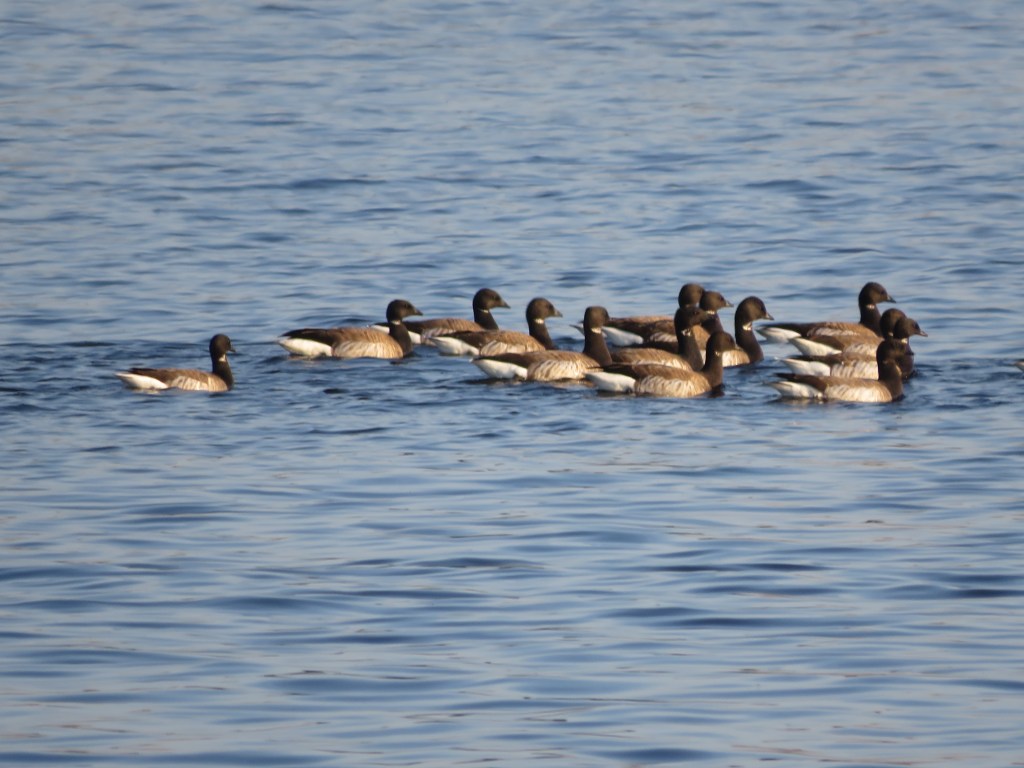
This energized me. Brant were observed about a week before on the Ottawa river, but without any reports since, this was truly unexpected, as I had thought that this very ephemeral species had moved on towards its Arctic breeding grounds. Gatineau fortunately happens to be a pit stop on this goose’s migration between the Atlantic Ocean and its high Arctic breeding grounds. Over the next 30 minutes I heard several new species including Tennesse Warbler, a dull greyish-green bird with a distinctive accelerating song, Scarlet Tanagers, whose song has been described as a Robin with a sore throat, and the sweet whistles of Baltimore Orioles. What a start!
By 6:45 I was on my bike, heading into Gatineau Park, at a very slow pace. Swainson’s Thrushes were singing everywhere. By the time I reached the parking lot for the main entrance at 7:30, I had 10 warbler species including Bay-breasted and Cape May, plus four species of vireos, more than I observed on Birdathon-1. However, other species that I was expecting, including Winter Wren and Wood Thrush, were not at the rendez-vous. Was I too late, or had they moved on from the past week? I covered a similar path with my bike that I had the previous Sunday, but I started nearly two hours later because of the rain. I returned home about 9:00 am for a short breakfast, before heading down to the river behind the University on my bike with my scope in tow. A Blackpoll Warbler sang from just above me along the bike trail. As this species is another “ephemeral” migrant . . . there one day and gone the next . . . I took extra time to seek it out and photograph it with the new camera.
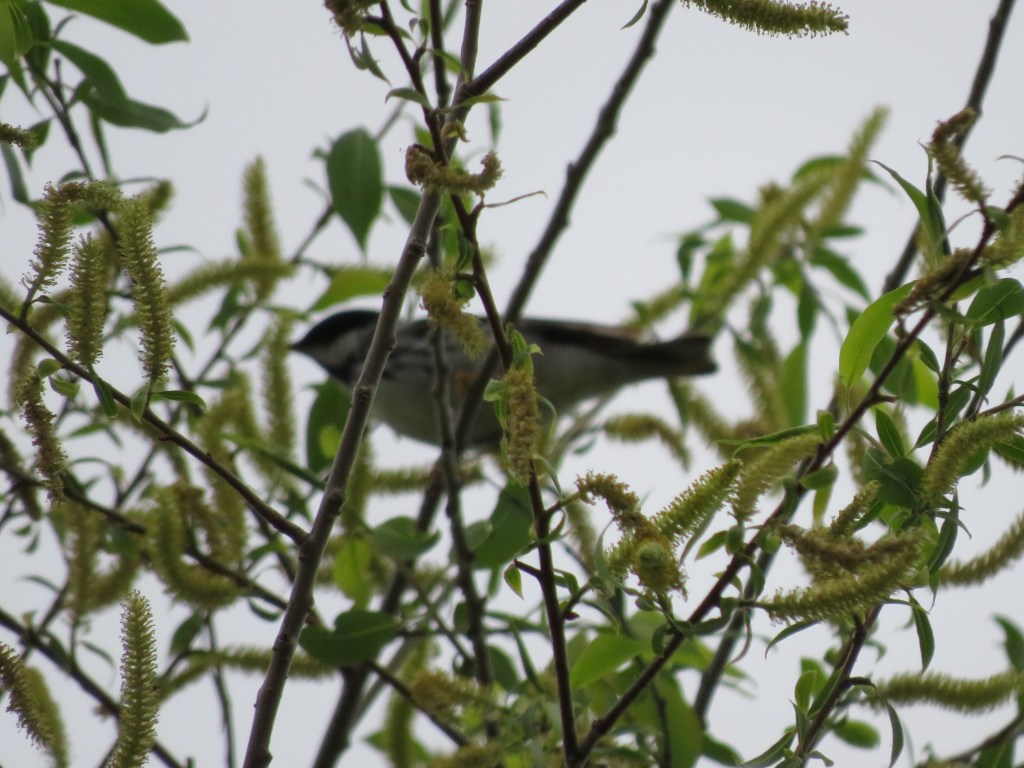
From the lookout over the river, I could clearly see the bird colonies with the usual suspects – Ring-billed Gull the most numerous, followed by Double-crested Cormorant, with a handful of Black-crowned Night Herons and two pairs of Herring Gulls, at the highest points of the colony. I learned years before that it is not uncommon for a larger species of gull to nest at the highest point in these multi species colonies, and both island colonies were consistent with this pattern.
Eastern Kingbirds were much more common along the riverine vegetation. Such a fun, exciting, and appropriately-named bird, snapping up flying insects, and chasing any larger bird that dares venture into its territory. High overhead a distant but emphatic “Keeeerr” caught my attention. Scanning the sky revealed 6 very high Common Terns moving west . . . unexpected! I rode on to my vantage point over the Ottawa River near the Champlain Bridge where I had spotted three species of Merganser a week ago. This time no Mergansers, though the very handsome Wood Ducks were there.
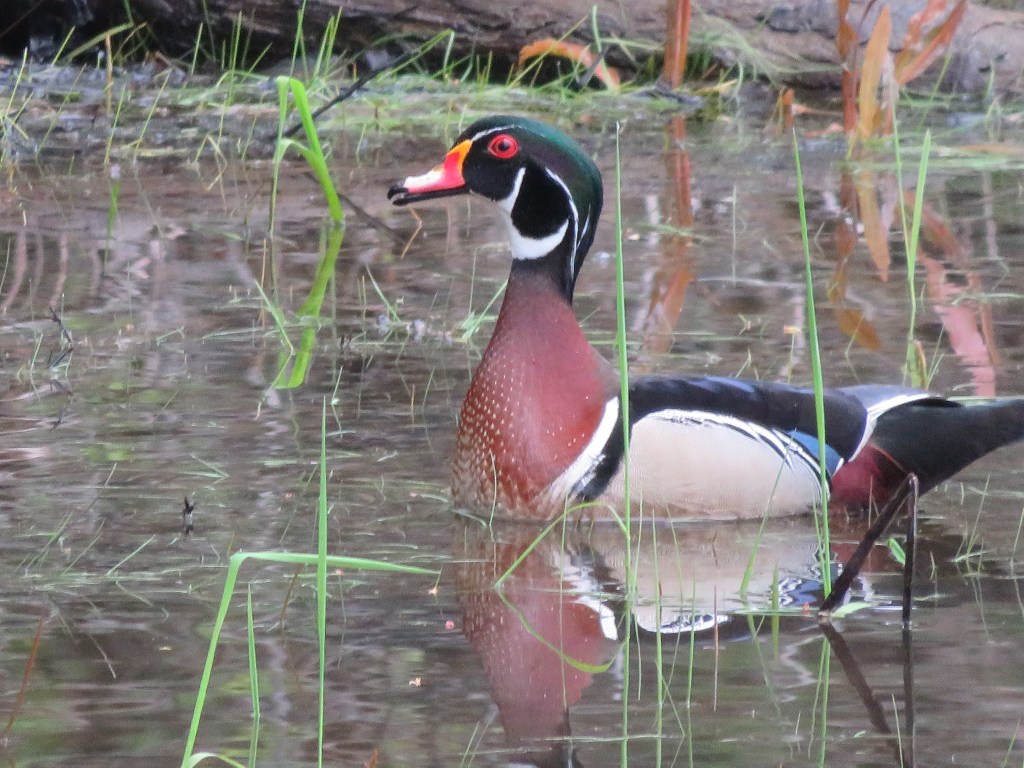
Leaving the river, I rode to the community gardens where the mama Killdeer continued to brood her babies within a hazard-taped-off area. A few other species were added on my way back home, and by the time I parked my bike I had reached 75 species. It was noon, and I was at 75 at 10 am the week before, so I knew getting to 83 would be tough.
At 2 pm, after lunch and a short nap, with my batteries recharged, I left for a long walk into the Lac des Fées sector of Gatineau Park. I had my scope, disassembled on my back, along with binoculars and a camera. Early during the walk I heard a Yellow-bellied Flycatcher, singing in a cedar forest, about a kilometre from our place. Just before I had mused about the lack of flycatchers, so it was as if my prayers were answered. Shortly after, I spotted the Great Horned Owl, who has suffered from non-stop verbal abuse by a murder of crows for several weeks. I glimpsed its large rounded, brownish wing as it fled from its adversaries.
Walking along the trail near Lac des Fées, after spotting a Belted Kingfisher, I noticed another flycatcher that called distinctively from the shrubs in front of me. Eventually I was able to observe it sallying back and forth, greenish-grey with wingbars and a very faint eye ring. An Alder Flycatcher! Again, I was delighted. I continued onto the lookout over Lac des Fées. To my disappointement, there was a young person with fishing rod and a ghetto blaster playing loud music across the lake in exactly the spot that was the only habitat for shorebird species such as Yellowlegs or Solitary Sandpiper. Undeterred, I scanned with my binoculars the shoreline then the treeline. A small bird at the top of a tree, across from me but about 200 metres away caught my eye. Another flycatcher? I had a hard time judging size and could not see field marks with my binoculars, so out comes the scope. This bird was very cooperative, despite the disruptive kid about 50 metres away from it. The bird would fly off in pursuit of some insect, then return to its perch. Once I got the scope on it, I noticed it was looking away from me, so I only saw the back initially. What grabbed my attention were tiny white patches on the sides of its back, that appeared to be covered up by the wings. The only flycatcher that I know with these white pathes is the Olive-sided Flycatcher, a threatened species in Canada. The patches were barely visible and I could not see the front of the bird, but, as if it could hear my thoughts, it moved its wings and revealed two beautiful large white patches confirming its identify. Eventually it changed position, flew off and returned and I was rewarded with wonderful views from the front also. I managed to take a few pictures that were not great because of the grey background and the distance. Three species of flycatcher, all tough ones to find on most days, made this afternoon walk particularly rewarding.
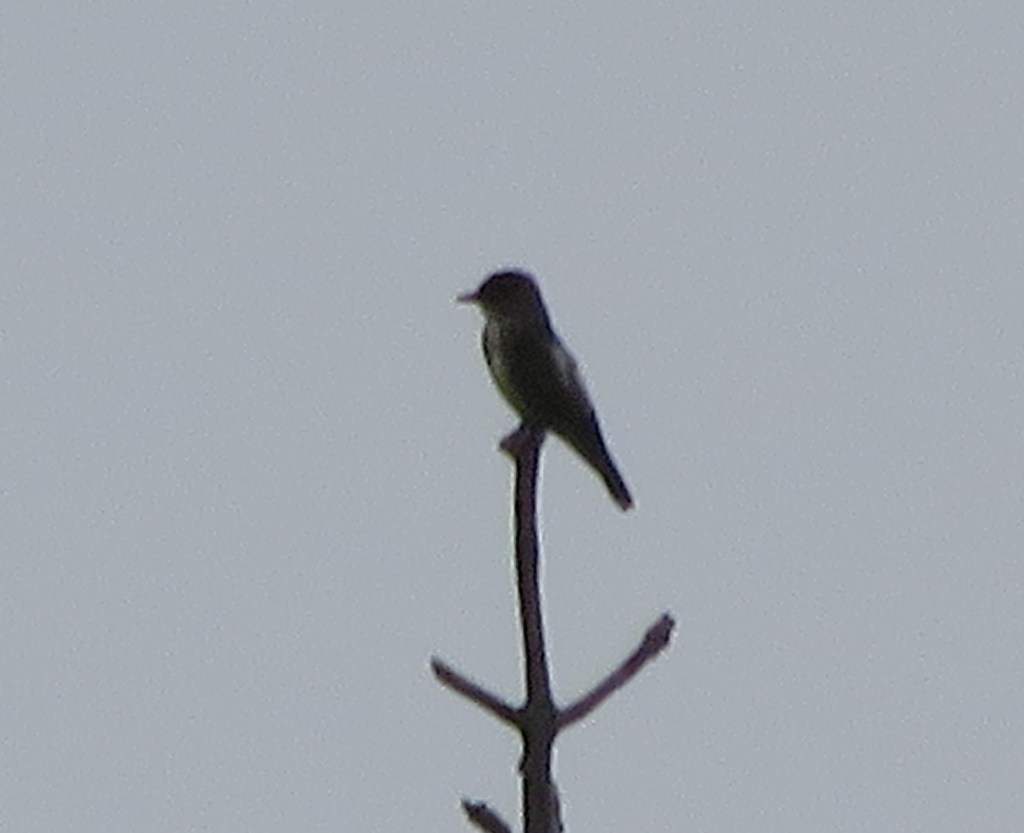
I returned home for dinner at 6 pm, tallying up at 80 species, three short of my target from last time. I decided that my best hope for adding a few species was to return to the area near the bridge where I might find the Hooded Merganser, and then head into Gatineau Park, hoping that either the Winter Wren or the Wood Thrush would be vocalizing near dusk. The bridge proved to be well worth the visit. As soon as I got off my bike, I noticed a pair of Hooded Mergansers on the river. They had heard my thoughts.
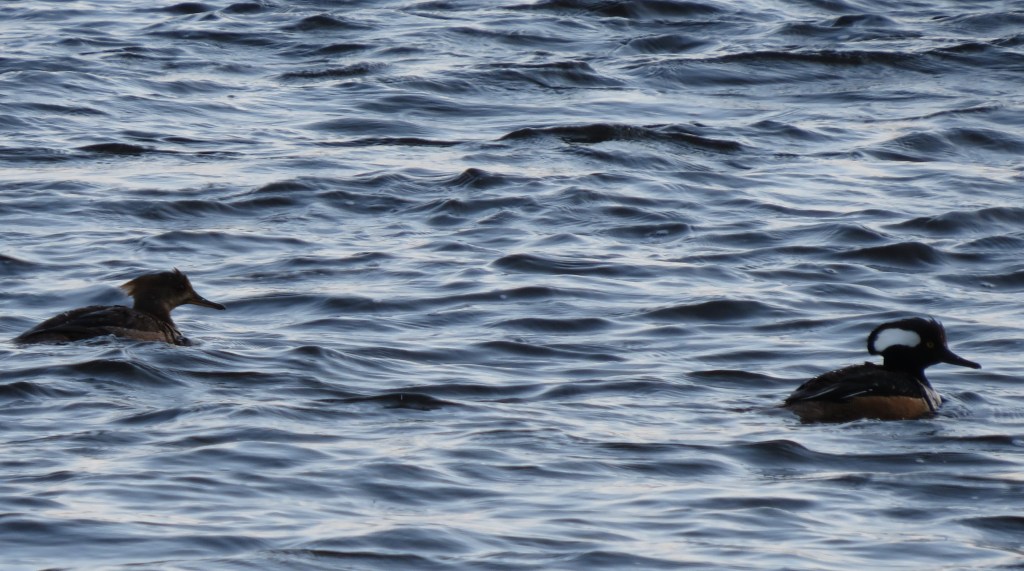
A scan with the scope revealed two Common Mergansers further off, under the bridge. Suddenly I was at 82 species with about an hour of sunlight left. With wind in my sails, I rode into Gatineau Park. Try as I might, I heard no new species. Finally, at 8:40, I started heading back, passing through an area where I had picked up a White-throated sparrow the week before. I whistled my best White-throated sparrow song, but no one answered. Finally I headed into a subdivision in hope of something, anything to get me to 83, as time was running out. Then from high overheard I heard it. “Peet” “Peet” Unmistakable. I stopped my bike immediately, searched the sky and there it was. Species 83, a Common Nighthawk. Fittingly another Federally Threatened bird species, that migrates late in the spring, and was likely heading much further north, having spent its winter in Brazil. Nighthawks have a special place in my heart, due to a nostalgia from knowing the species as a child. Hearing and seeing the Nighthawk was a fitting end to Birdathon-2, on which I observed exactly the same number of species as I had on Birdathon-1, eight days earlier. even though at least a third of the species were different. Here is a last treat video clip that I took from a wetland near the Ottawa River.
Again, if you are able to support BPBO by sponsoring me, I would be extremely grateful. Please go to this link to make a donation.
Thank you so much!
Ted
Every year since 1981, I’ve participated in a “birdathon.” I learned about this in 1980, when I spend six weeks as a migration monitoring assistant with the Long Point Bird Observatory. The next year I joined in the Bird Observatory’s fund raiser, then called the Baillie Birdathon, in honour of Canadian ornithologist James L. Baillie in what has turned out to be a great day of fun as well as a fundraiser. Truth be told, I look forward to doing this birdathon as much as any single moment of the year. For the first few decades, I would get sponsors to pay me a per species rate, so there was a great incentive to see lots of birds. A few times I topped 150, which always was a bit of a magical target. I usually spent the day with other people – initially I recall doing birdathon with Phil Weller, a U of Waterloo friend and colleague. We did our birdathon in the Long Point area, which usually included walking from the Provincial Park to a Bird Observatory station called Breakwater, about half way out the peninsula, and back to the Park, about a 15 km round trip that involved wading through deep cuts of cold Lake Erie water in late April or early May. It was hardcore! We started at 4 am, and usually finished red-eyed and delirious around 11 pm. Once I started growing my family in the late 80’s and early 90’s, birdathons shifted to different areas, including Waterloo Region. Others, including family, joined in on the fun. Eventually, I connected with my buddy Rod Steinacher, and another friend Bruce Kellett. We started doing birdathon together on the upper Bruce Peninsula where Rod and his wife Noreen started living.
In 2001, Rod and I, along with a few others, co-founded the Bruce Peninsula Bird Observatory (BPBO). One nice feature that Bird’s Canada (which evolved from the Long Point Bird Observatory) has for Birdathon, (which is now called Great Canadian Birdathon), is that you can donate most of the funds you raise to an organization/charity of choice. Of course we chose our new baby, BPBO, as the recipient of our efforts. That tradition, of doing a birdathon on the upper Bruce Peninsula with Rod, carried on for nearly two decades, despite my move from near Guelph to Gatineau Quebec in 2006.
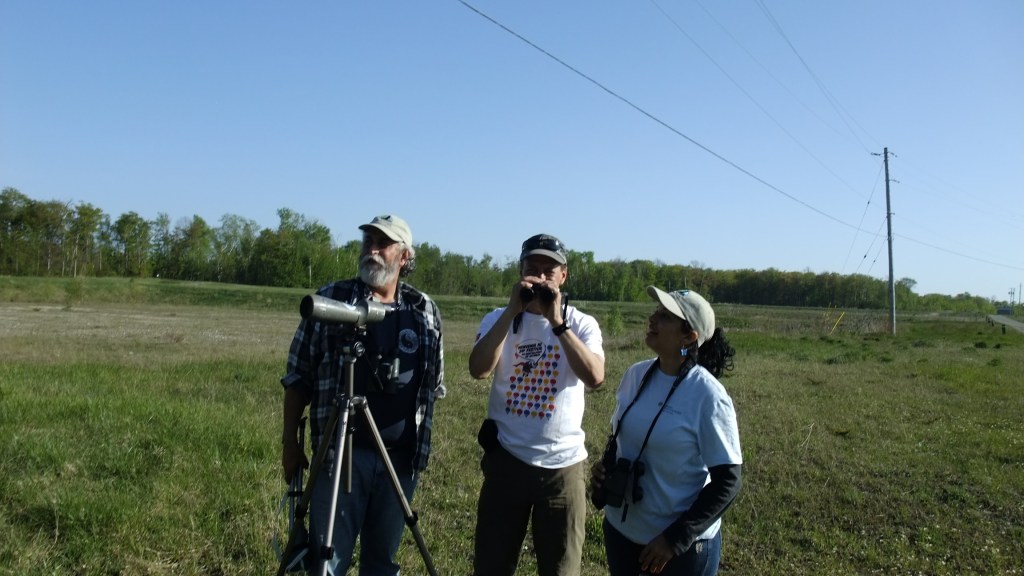
Three years ago, my daughter graduated from University of Ottawa’s School of Medicine, and the convocation ceremony was about the same time as birdathon. As the Steinacher’s didn’t want to miss my daughter’s honour and celebration and we didn’t want to forego a birdathon either, we chose to do it in the Gatineau/Ottawa area for the first time. The last two years I returned to the upper Bruce, but this year, due to Covid-19, no one is travelling anywhere. I decided to continue doing my birdathon for BPBO, alone for the first time, but to stay near our place in Gatineau – within 3 km, and only travel by foot or bicycle. No cars, or motorized travel. I also decided to do it twice. Why? Because I love spending a day hunting for birds. My senses are sharp, my body is on high alert to every movement, every sound. I really love pushing myself to find everything. It is a great rush of excitement and I also enjoy the physicality and eco-friendly aspects of no motorized travel.
Last Sunday, I did birdathon-1 starting at 3H30 am on our balcony, where I heard the first bird – a Swainson’s Thrush flying over, giving its distinctive call note. I then rode my bike into the southern end of Gatineau Park, in the dark, nearly 3 km from my house, to hear a Great Horned Owl hooting away, followed by a concert of Hermit and Wood Thrushes. It doesn’t get much better. The day went on to have its typical highs and lows. I was at 50 species by 7 am. 75 by 10 am. But by 5 pm, I was stuck at 81, only 6 species added between 10 am and 5 pm. I did a final bike ride where I added the two last species of the day, an Eastern Kingbird and a Pileated Woodpecker. After that, I did a long walk from 7 pm to 9 pm but added nothing new.
That’s the way a birdathon can go. I calculated that I walked about 14 km and biked nearly 30 km! All that in an area with a diameter of 6 km. I believe that 83 species for a urban area without grassland habitat or shorebird habitat was a good result, especially during a year with frighteningly few birds. That will be another blog story. In the meantime, I am preparing for Monday. Why Monday? Well, western Quebec and Eastern Ontario have been under a high pressure system with clear blue skies and warm temperatures for over a week, which means that the birds that are migrating up from the south are, for the most part, not stopping, but continuing on to the boreal forest. So. I am taking the day off work on Monday to do Birdathon-2 because it is expected to be rainy. Why, you must be wondering, am I planning on birding on a rainy day? I will be doing so (hoping it doesn’t rain all day), as I am counting on the clouds and rain to halt the migration so that birds are forced down and there will hopefully be more birds to find.
I’ve noticed relatively few individuals stopping in the trees near my place over the past several weeks due to the “great weather” as some people dear to me might say. Despite this “great weather” my “birding from the balcony” list is good this year because I’ve been working from home since mid-March and that has meant an hour or two of birding nearly each day from the house. When you can do that, eventually you see more species. I am already at 97 species for the year from our apartment, which is pretty good. But I’ve noticed that other good birders who keep “yard lists” on eBird are doing equally well, undoubtedly for the same reasons. So, I’ll fill you in, dear reader, with details of my second birdathon this Monday. Please sponsor me, if you haven’t already. To do so, please Go to this link
I will report back soon.
Signing off. .. .
Ted
 birdingfromthebalcony