I’ve been travelling a lot in August – trip to the Saguenay, trip to Vancouver, and trip to Waskaganish – and not spending much time around the apartment or on the balcony. In the last few days, two species were added though, putting me at 76 coming into September – Red-breasted Nuthatch and Purple Finch. Red-breasted Nuthatch (Sitta canadensis) is one of my favourite birds. I hope that they hang around this winter. We took the sunflower seed feeder down in June and since have only maintained a nyjar feeder and the water.
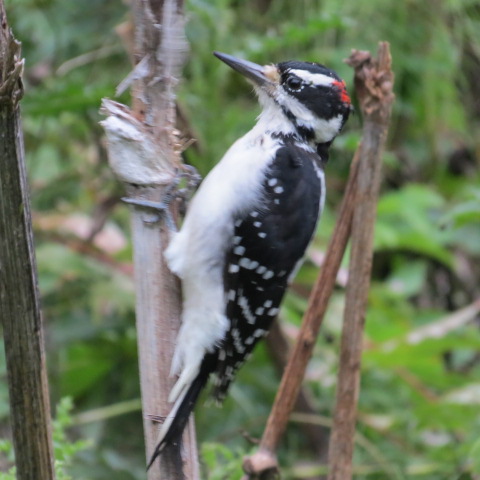
New camera works well!
For the last month, the activity of Goldfinches and Chickadees on the Nyjar and the water is non-stop. These birds are so entertaining. We noticed young goldies, as we call them, hanging on the feeder beside their parents, begging to be fed with high squeaks and wing flutters. They are totally endearing! As soon as we move the door to the balcony, the goldies leave, but the Chickadees are nearly fearless. We can be standing a metre from the feeder and water, and the Chickadee will still come. We have had some visits from Ruby-throated Hummingbirds also. Hopefully my colleagues will update me soon, and at the end of September, I can present the whole picture, as I edge closer to 80 species.
This post is exceptional in that I am using it to share the story of my birdathon in 2012 with my potential and actual sponsors. Normally the blog is about birds observed from our apartment in 2012. This post describes my birdathon around Cabot Head on the Bruce Peninsula. At the bottom of this post is information on how to sponsor me. All of the money raised goes to support bird conservation, and most supports the Bruce Peninsula Bird Observatory’s Migration Monitoring program. My short-term goal is to raise $500. However, if you spread this, you could help me double that goal.
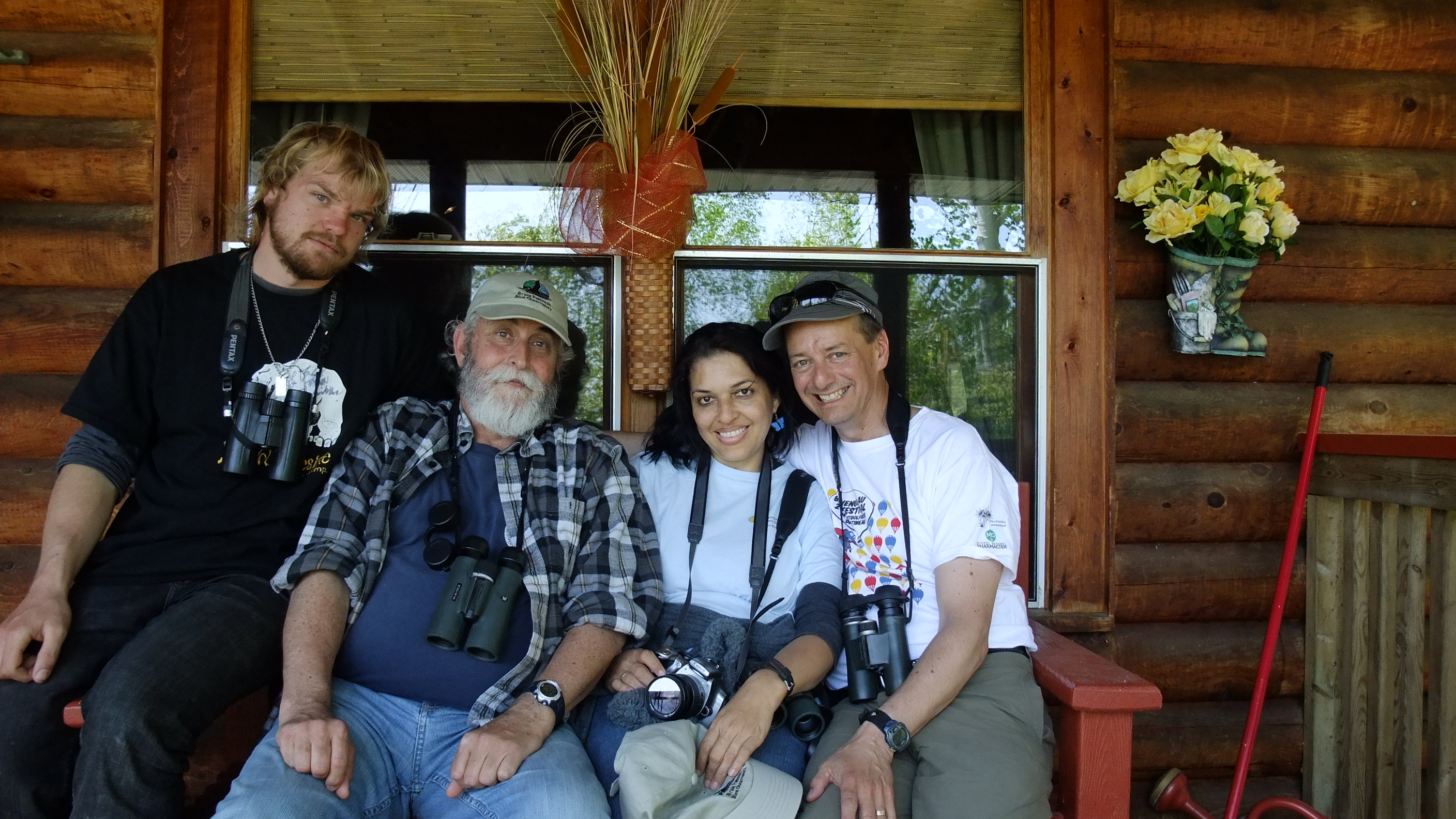
The 2012 Team – Andrew, Rod, Salvadora, Ted
On May 19th, I teamed up with my usual Birdathon partner Rod Steinacher, the new Station Scientist at Cabot Head Research Station for BPBO Andrew Sawyer, and our very special guest from Managua, Nicaragua Salvadora Morales. Rod and I had started at 4 am listening to two federal species at risk: booming Common Nighthawks and wailing Whippoorwills near the Red Pine barrens along highway 6. What a great way to start! We added another species at risk, Golden-winged Warbler, as well as Clay-colored Sparrow and the usual gaggle of scrubland species near Lark Whistle, before driving to our rendezvous at the Cabot Head Research Station. It was about 6 am when we me up with our other teammates, and spent the next several hours birding the environs of Cabot Head. Having two very sharp-eyed observers with us made the task someone easier this year though we never drove over 30 kilometres per hour, had good meals, and included the all important siesta in our day! A highlight from the Research Station was sitting on the picnic bench overlooking Wingfield Basin, and watching several raptors including Merlin, Peregrine Falcon, Red-tailed and Broad-winged Hawks spiral over our heads before turning west.
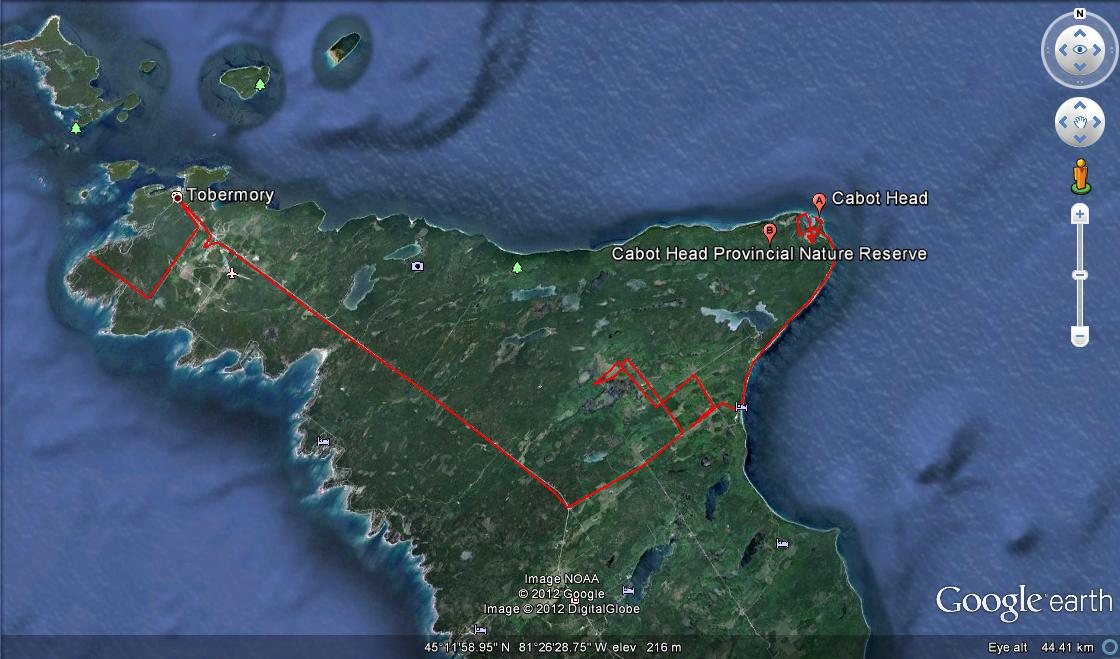
Birdathon route – more or less
We left the station, driving around to the Lighthouse on the other side of Wingfield Basin. The conifers bordering the walkway along the finger of land pointing across the mouth of Wingfield basin were teaming with warblers. Of note were a numbers of warblers with very high-pitched “tssee tssee tssee” type songs, one distinctly higher than the other two, another with a more two-syllable quality, but all near the end of most mortals’ hearing range. I think that for me, it was the first time in recent memory, perhaps ever, I was able to observe Cape May Warbler, Bay-breasted Warbler and Blackpoll Warbler in the same tree at the same time– and in numbers! We feasted on the sight of these birds. Our bubbling enthusiasm stopped a few passing birders with big cameras in their tracks and they proceeded to ‘capture’ the spectacle. I was especially happy that Salva could experience the crippling views of Canada’s three classic long-distance migratory boreal budworm warblers. Bay-breasted and Blackpoll fly through or over Nicaragua en route to and from wintering grounds in South America. Blackpoll has one of the longest migrations of all warblers, dispersing in the vast forests of northern and central Brazil. Cape May Warbler may over-winter on the Caribbean slopes of Nicaragua and southern Central America, but is mainly on the island chains in the Caribbean.
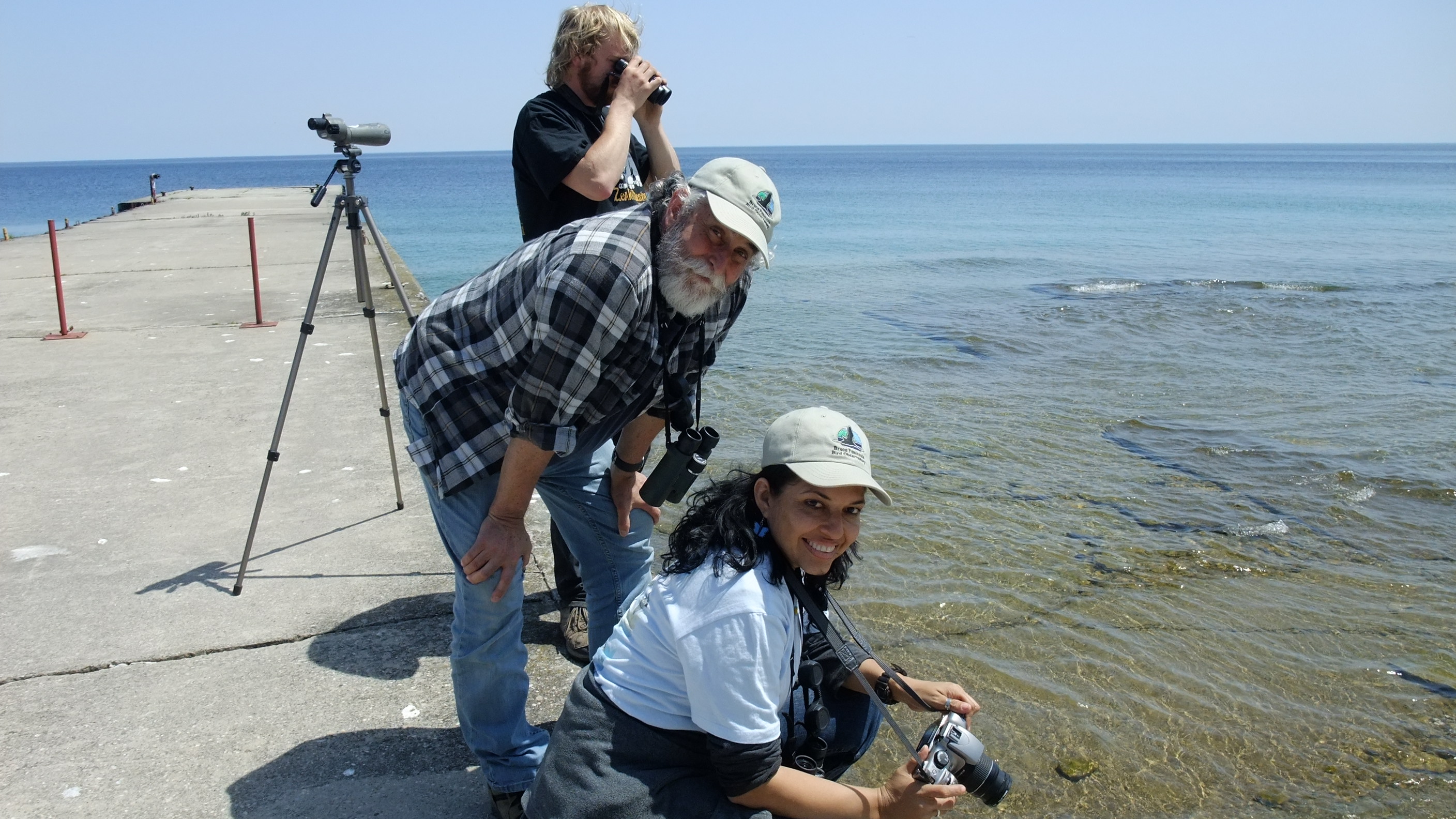
Salvadora, Rod and Andrew at the dock of Dyer’s Bay
Departing from the Lighthouse, we headed south towards Dyers Bay. Along the way, we observed a few White-winged Scoters, Long-tailed Ducks, Red-necked Grebes and Common Loons to go along with the Common and Red-breasted Mergansers. Red-necked Grebe is the trigger species for the Cabot Head Important Bird Area which stretches from Dyers Bay to High Dump.
By the time we left Dyers Bay, shortly after noon, we were well over 100 species, and starting to get hungry and tired. It was sunny and warm – a pattern that would become the enduring memory of the summer of 2012. The combination of warmth, sun and fatigue eventually caught up with us, and we drove to Rod’s to take our usual siesta (a Canadian tradition that we wanted to share with Salvadora), before hitting the road around 5 pm.
With renewed energy and vigor, we set off for our next stop, the Tobermory sewage lagoon, a birding hotspot where there were sure to add
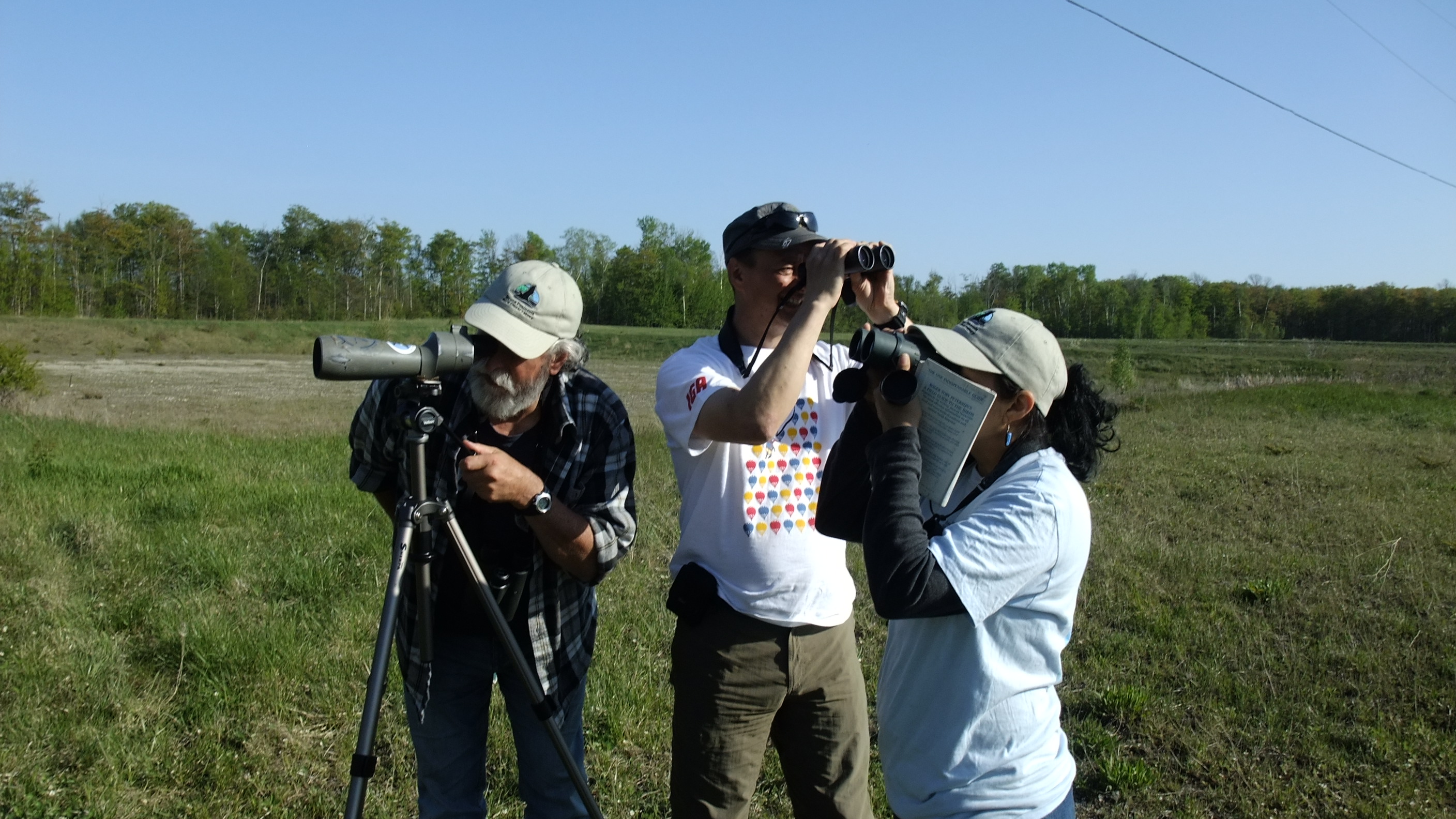
Taking time to be silly
some species, and we were not disappointed . . . Bank Swallow, Northern Shoveler, Ring-necked duck, Virginia Rail, and Red-bellied Woodpecker were all there. However, the real show was along the edge of the forest that was bordered by a small slope covered with Staghorn Sumacs. Feeding on the berries were several brilliantly coloured Eastern Bluebirds. Amongst them were four Scarlet Tanagers, two males and two females. To top things off, two Red-headed Woodpeckers, a species we had not observed on birdathon in several years, foraged on a tree along the forest edge. At one point, all of the birds were within the same binocular view, lit-up by the late afternoon sun. We were out of superlatives to describe the beauty of this scene.
Filled with awe, we drove to Tobermory to look for House Sparrows and Pigeons. OK, this put a bit of a damper on the awe inspiration, particularly because the local House Finches that Rod swore up and down by, eluded us. I guess our timing coincided with their siesta.
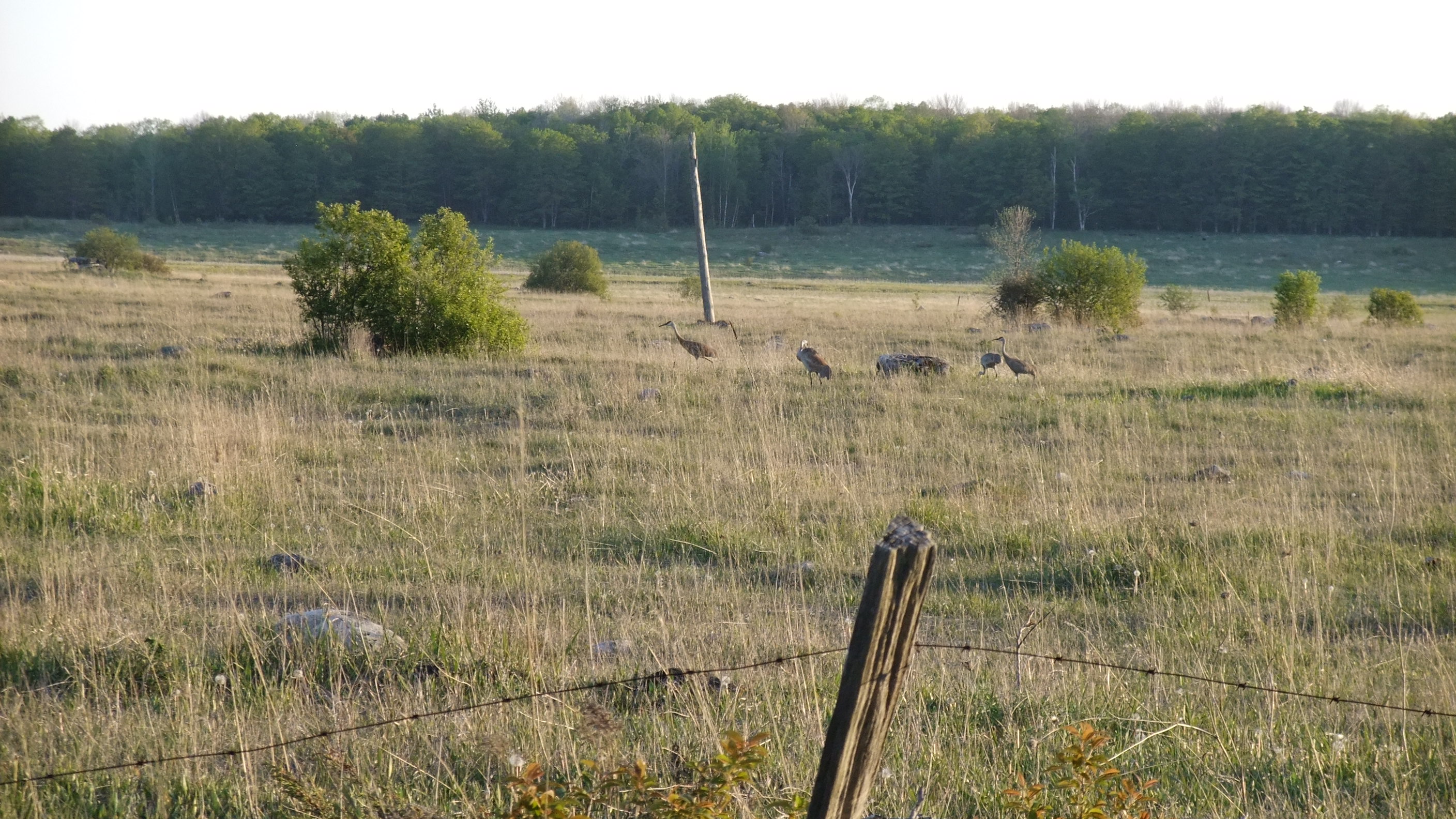
Sandhill Cranes at Crane Lake
The last major stop, the best way to close out the day, was Crane Lake in Bruce National Park. Just before getting there, Salva spotted an Upland Sandpiper on a rock in the hay-field along the Dyers Bay Road, that left us both dumbfounded about how she managed to recognize it back in the field amongst the grass, and also cognizant of how lucky we were to have her and Andrew as part of the team (there were a few of those moments from both of them). We spent about an hour before sunset wandering down to the wetland, spotting some Wood Ducks, hearing Grasshopper Sparrow and Marsh Wren. The expanse of Crane Lake is breathtaking. It also lives up to its name, as we always encounter numerous Sandhill Cranes, wandering in small groups quietly foraging, or filling the air their explosive bugling.
A last stop in the dark along the Crane Lake Road afforded us our final species – Eastern Screech Owl. When we got back to Rod’s the tally was a satisfying 135 species. My description captures the highlights of the day, but there were several long periods during which we added no species, and we always end up shaking our heads over the species we missed.
If you wish to sponsor me for birdathon, please go to my birdathon sponsor page , and help me reach my goal of raising $500 to support BPBO’s migration monitoring program and the Baillie fund.
Many Thanks!
Ted
Back in May, I intended to update this blog at month’s end. My apologies to my few followers of the blog for taking so long. A few days before the end of May, Al reported to me to be at 103 (way ta go Al!), though he was not confident that he would break his year total of 109 for 2011!! I was stuck at 73 after May 27th, and far short of my goal of 80 species by June 1. Here is what happened.
May and June are extremely busy months for me, birding for pleasure, birding obligations, bird research contracts, and my bird conservation work at Nature Canada (not to mention what seems like endless 6 to 10 hours drives across Ontario). Everything seems to peak over these two months, meaning reduced sleeping hours – chronic tiredness, and no time to update the blog. However, waking to the call notes of a stunning male Rose-breasted Grosbeak and the magical notes of a Wood Thrush on May 5, that for some odd reason, frequented our neighbourhood for a few days, or being literally ‘called out’ onto the balcony by a loud clucks of a hovering Peregrine Falcon on May 9 (no matter how hard I try, I just cannot explain that one), and feasting on brief glimpses of colourful warblers working the small branches and foliage of the Ash and Maples along the fringe of Gatineau Park as my upper body hung out of the window on the east side of the house, were all delightful moments and highlights. May 11, which was”International Migratory Bird Day,” was particularly good for Warblers – 7 species observed from the house, including 3 new species plus a striking Scarlet Tanager. The “budworm” warblers (those that specialize in eating Spruce budworm on their breeding grounds in the vast Canadian boreal forest – including Bay-breasted (May 8), Cape May (May 15), and Blackpoll warblers( May 22), all spent a few days foraging the tree tops around our place, often singing their high-pitched songs intermittently between feeding forays. The last new species to add in May was a Yellow Warbler on the 27th.
After the 27th, a depressing period of almost two months followed without a new species of bird, and not for lack of effort. OK, I’ve really cut back on those 5 am moments on the balcony since about June 10. More than once, my wife asked me how long ‘it’ was going to last – and eventually the idea of more sleep and a more pleasant awakening won over stumbling out of bed, groggy-eyed, after 4 or 5 hours of sleep to watch and listen to the city wake up to the songs of House Sparrows, Robins, Cardinals, Chickadees and Goldfinches. So, on the 20th of July, when a Purple Martin from the colony about a kilometre from our apartment finally drifted to within earshot, a new species was added, the spell was broken, and I can post again!
The Purple Martin is a special bird for me, and one that I was expecting about now. Let me explain. Each of the six years that I have lived on Boucherville, I have been aware of a colony of Martins near the Ottawa River, between here and the Champlain bridge. I noticed this colony on my semi-regular runs along the bike path that runs parallel to the river all the way to the Aylmer marina on Lac Deschenes. Purple Martins arrive in early May, and nest in large apartment-like houses. The largest of the swallows in North America, the Purple Martin has declined perilously in Ontario and Quebec, perhaps by over 90% in the past 40 years. Hearing and seeing them in the spring is enough to put a big smile on my face. I have noticed that each year, the birds follow a similar pattern. They feed over the river and otherwise stay fairly close to their home over the months of May, June and much of July. Then something happens, the young are out feeding, and they gradually drift further and further from their house, eventually working their way into the airspace above our place. It is always in the third or fourth week of July that this happens, and this year was no exception.
Here is what else is special about this bird for me. Purple Martins migrate from southern Canada and the eastern United States to Brazil. Even better for me is that they go all the way to Sao Paulo state where my wife is from. In fact, there are even patterns of Martins in the cobblestone sidewalks of Campinas, the city where Cris was living when we met. The Brazilian (portuguese) name for Purple Martin is Andorinha azul – a beautiful name. Apparently some villages and towns in Sao Paulo State celebrate the return of the Andorinhas each year from the distant north.
When Cris and I flew from Campo Grande in Mato Groso do sul, to Campinas at the end of our honeymoon in Brazil, the flight attendants were friendly and funny, and the entire flight experience seemed vaguely familiar. Before arriving in Campinas, I mentioned this to her, and she showed me a story in the on-board magazine of the company founder that she had read. The name seemed familiar, Clive Beddoe – ah, of course, he was a founder of Westjet. Yes, that was it, the flight reminded me of a Westjet flight. I liked that! His influence had worked its way into this small Brazilian airline! However, the big surprise that brought tears to my eyes happened when we “deplaned’ as they say now-a-days. We did this on the runway in Campinas, and for some reason, before walking away from the plane, we looked at it and saw that the plane had a name. . . “Andorinha azul” This put the icing on the cake for a perfect honeymoon between a Canadian man and Brazilian woman whose cities are connected by an amazing bird, the Purple Martin.
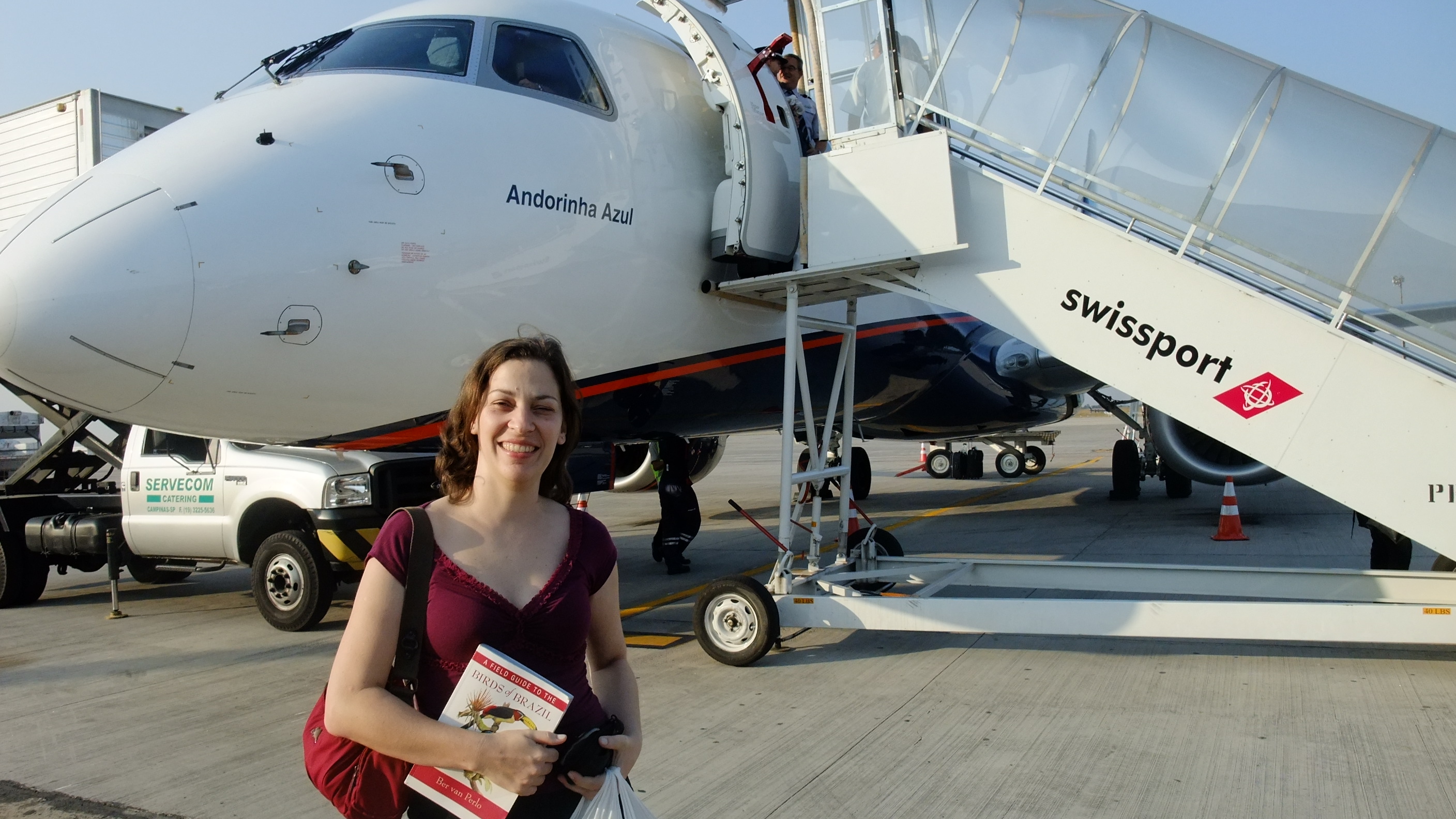
Cris in front of “Andorinha azul”
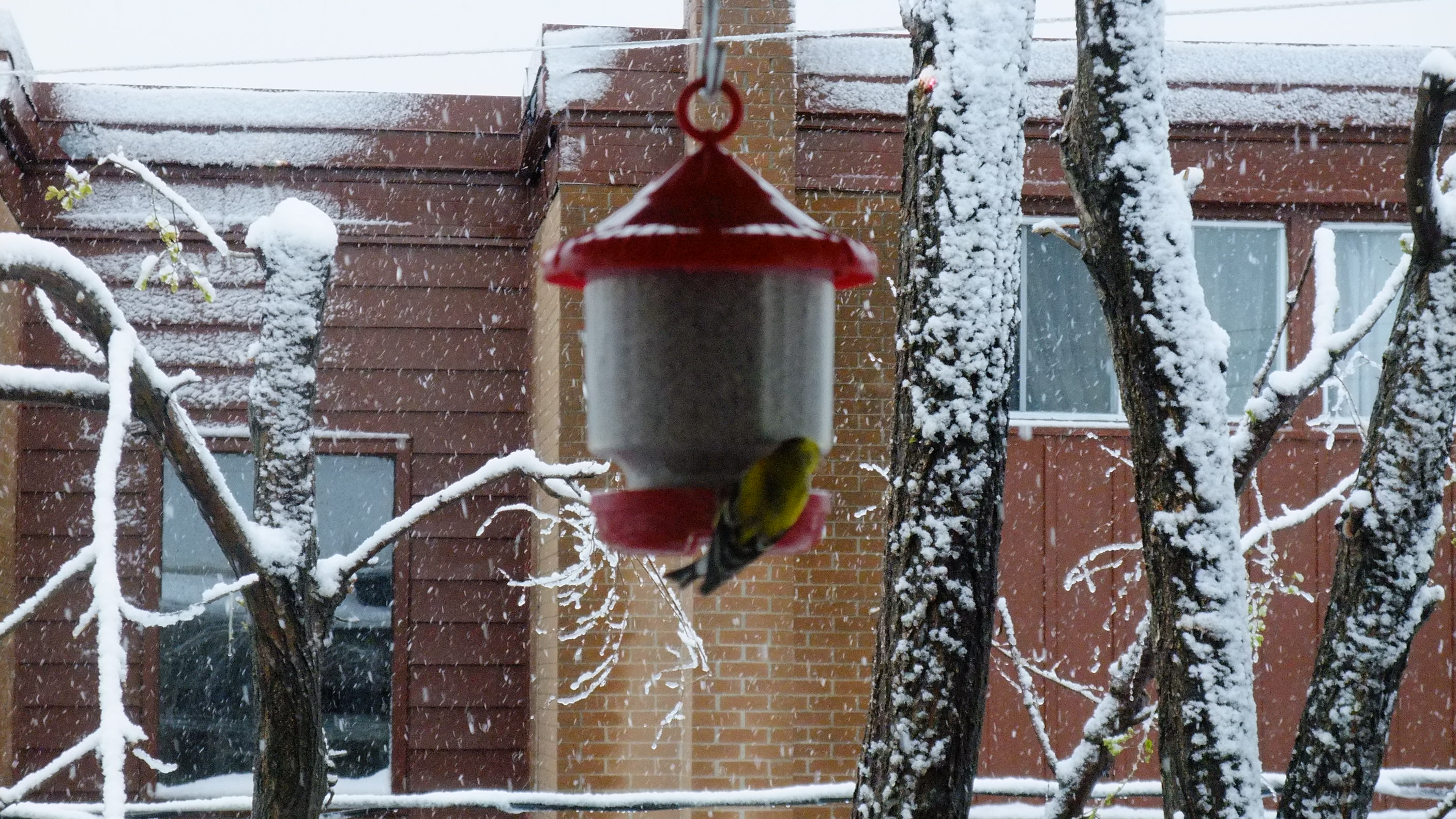
Surprise snow storm in late April
April started cold, and stayed cold with few reprises. The birds reacted, or not. Most of the month, with a few nice exceptions, was characterized by cold northerly winds, against which few birds dared migrate. Since my last post, after Sapsucker day, there has been little movement. A Chipping Sparrow here, a Ruby-crowned Kinglet there (which are singing so enthusiastically from the neighbour’s tall Spruce trees), a Pine Siskin, and a Merlin – one siting, perched on one of those very same Spruce trees beside Jacque’s house. Fortunately we are not in the Merlin’s territory. They have a way of making the song birds disappear, and this year is not the year for that kind of nonsense!
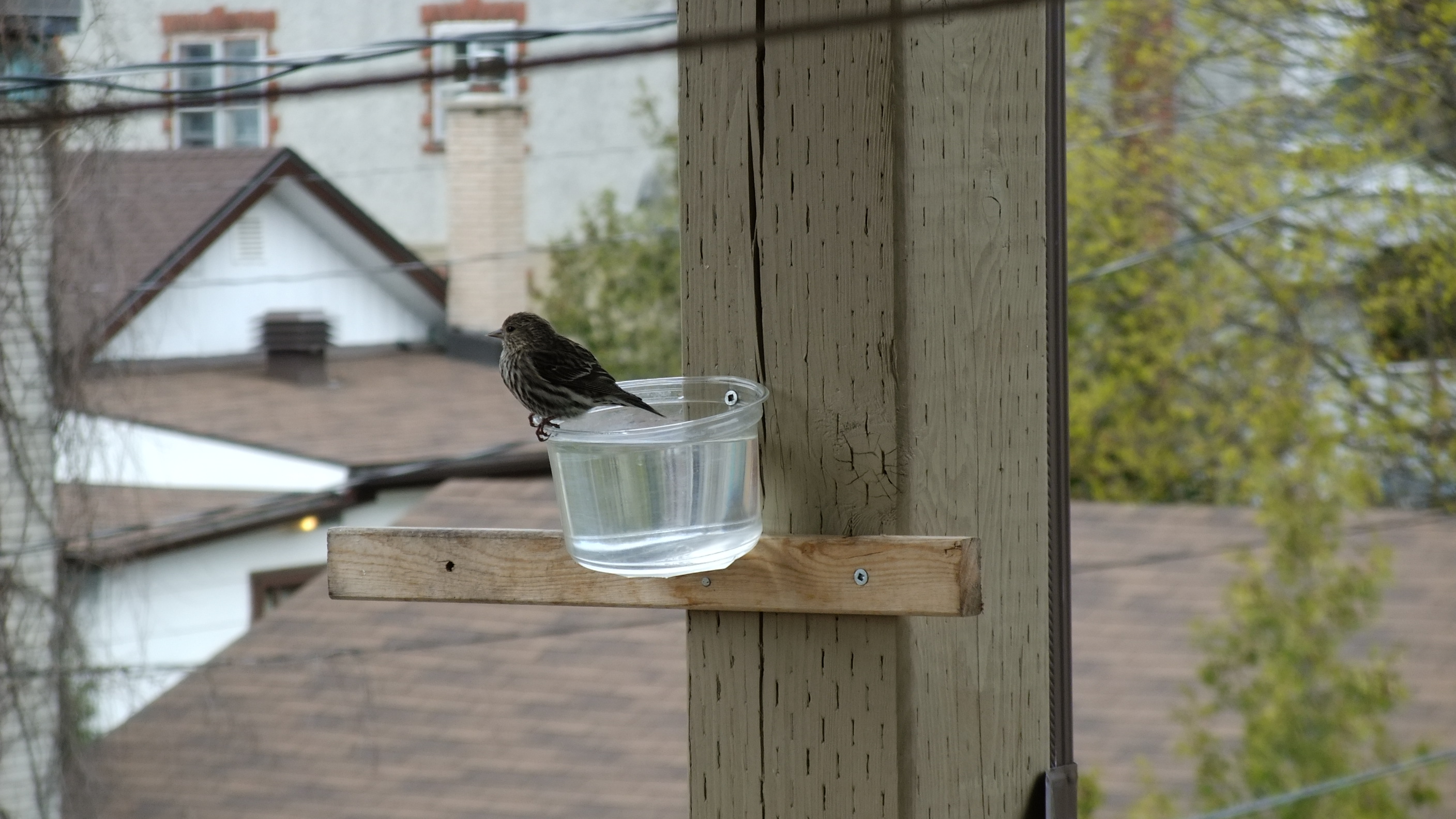
Pine Siskin at water
This past Sunday morning I was stuck at 42 species after a week with no birds. I really thought that 50 species for May 1 was within reach 2 weeks ago, but my hopes were dashed by that biting north wind. Hell, I could not even open the east window over Gatineau Park to listen and watch without risking hypothermia for an entire week! Anyway, this past Sunday I noticed the sun felt stronger, the wind had less bite, and I was determined to put in some solid time on the balcony. Within about 90 minutes of watching the river, I spotted many swallows – really nothing more than tiny specks, but a few of the specks appeared to be flying away from the river towards me! Shortly after, 4 Barn Swallows flew directly over the house! About 15 minutes later I added that pesky Brown-headed Cowbird that was eluding me. Around 8 pm, as the sun was setting, I came in and phoned my friend Rod, who has also decided to join the big year fun from his dream home on the tip of the Bruce Peninsula – on one of the major migration flightways in Ontario. I was listening to his story about a crazy encounter the night before with an alpha Great Horned Owl, surely tanked up on steroids, that chased him into his house, and sat outside the picture window staring him down, daring him to come out. . . . when just over our roof, in the fading light, a Great Blue Heron glided by. A couple minutes later a second sailed past. If I hadn’t been there at the window, I would have missed them. Hours and hours I had spent looking toward the mighty Ottawa River without seeing a singly heron, and two fly within about 5 metres of the room over my head the moment I least expected! That pretty much sums up birding, and the joy of the unexpected. So, this morning, April 30, the chip note of a Yellow-rumped Warbler rounded out my Big Year from the Balcony to May 1 with 46 species. Rod says that he is up to 61. As for Al . . . he has kept the pace up and is finishing the month at that lovely but overrated number, of 69.
Here is his story:“It is the last day of April and I thought I would send you an update. According to eBird, I have detected 69 total for 2012, and although many were ‘firsts’ in the previous months, 56 of the total were detected this month. There was one additional bird that is 95% Merlin, but it was distant, backlit, and I was using compact 10x ‘bins and was a little iffy to make the call (although I am pretty sure it was a Merlin). So 69 is where I stand. I had hoped for 65, but a single singing Savannah Sparrow, 10 fly-over Common Loons, 2 Common Ravens, an early Solitary Sandpiper today, and I am one away from 70. Although Sean has had boat loads of White-throated Sparrows, I have not yet had a single individual singing or foraging that has caught my eye. With the Solitary Sandpiper today I also had Nashville Warbler. I hope to get a Western Palm Warbler this year, as it eluded me last year…
I hope the birding has been fun for you so far, and tomorrow might turn out to be a big day of movement…
Al”
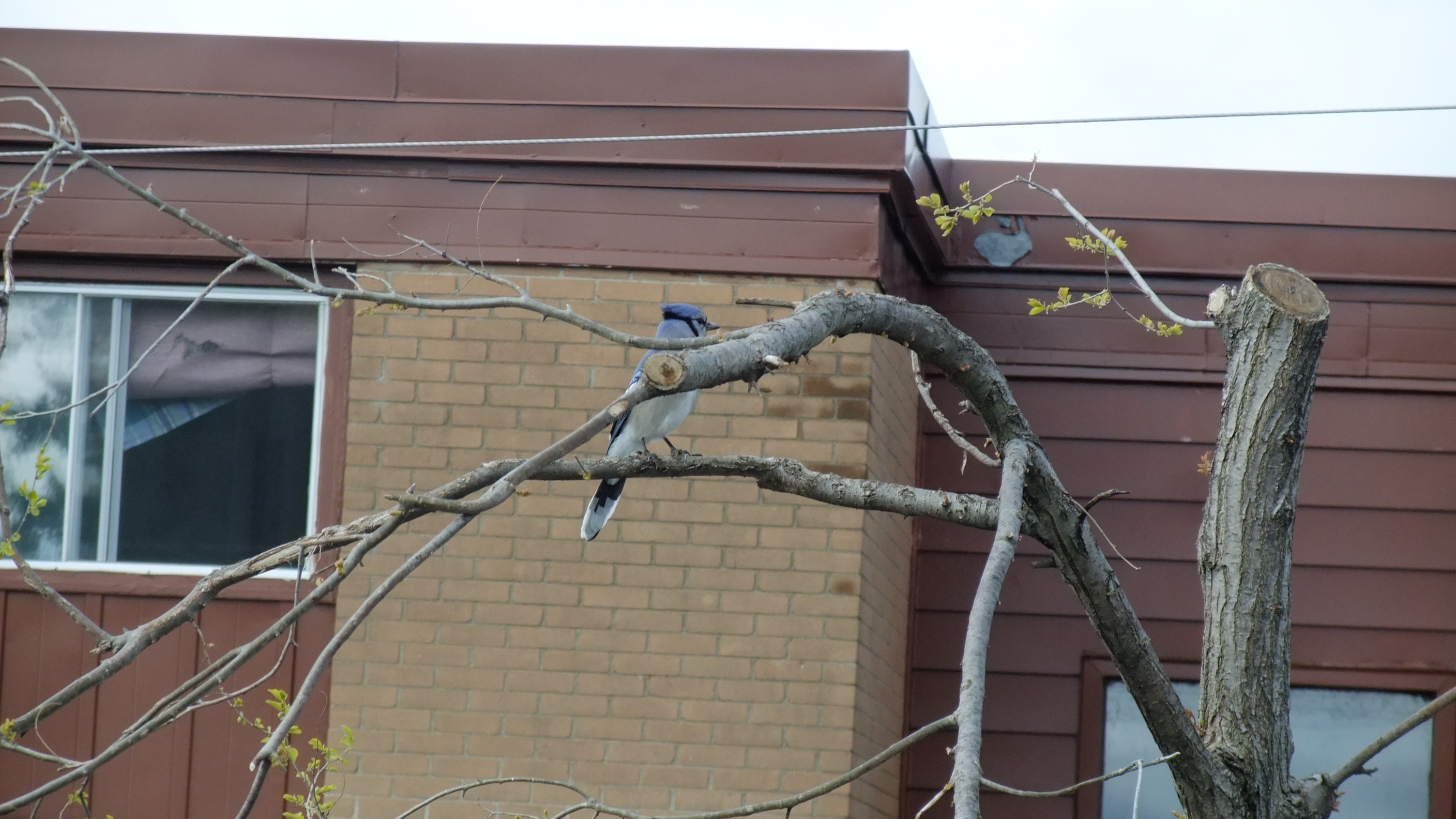
Cris photographs an elusive Blue Jay (which I have still not actually seen)
My Prediction? I think that Al will be around 100 by May 30, and I predict that I will have topped 80 species. Rod I believe will have forged ahead of everybody, and probably be pushing 120 or 130 by then.
|
The last few days have been pretty good, at least the potential to be good was there. I thought that I would finally narrow the gap between myself and Al on our big years. Well, not really, but at least I wanted to keep it interesting. Warmer weather (it became seasonably cool after that freak warm spell in March), and south-westerlies this time of year means a flood of new migrants pushing north. This past Sunday, it was worth getting up around sunrise to watch the early morning unfold from the balcony. Looking toward the Ottawa River, a dark speck materialized above the tree tops, over the buildings, and flying straight at me. A woodpecker for sure, but in bad light and a less than optimal perspective, I knew it was going to be a tough call. It went straight over the roof, and I still wasn’t sure, so I swung to the other side of the balcony, just in time to see the bottom of a dip in its undulating flight, and there it was, the white rump of the woodpecker we lovingly call “Whitebutts” or Northern Flickers. It flew another couple hundred metres over more houses and yards before landing in a tall tree on the edge of Gatineau Park where it start “singing.” About fifteen minutes later I heard, then saw my first Tree Swallow, high overhead. That was it for new species, but it was a great start to my Sunday. Then today, a work day, I awoke to different air, the sticky, sultry air that had flooded in overnight and pushed the thermometer to 15 degrees. (the mornings had only just started creeping over 0 a few days before). While preparing breakfast, I looked to the window and there, on the heavily trim
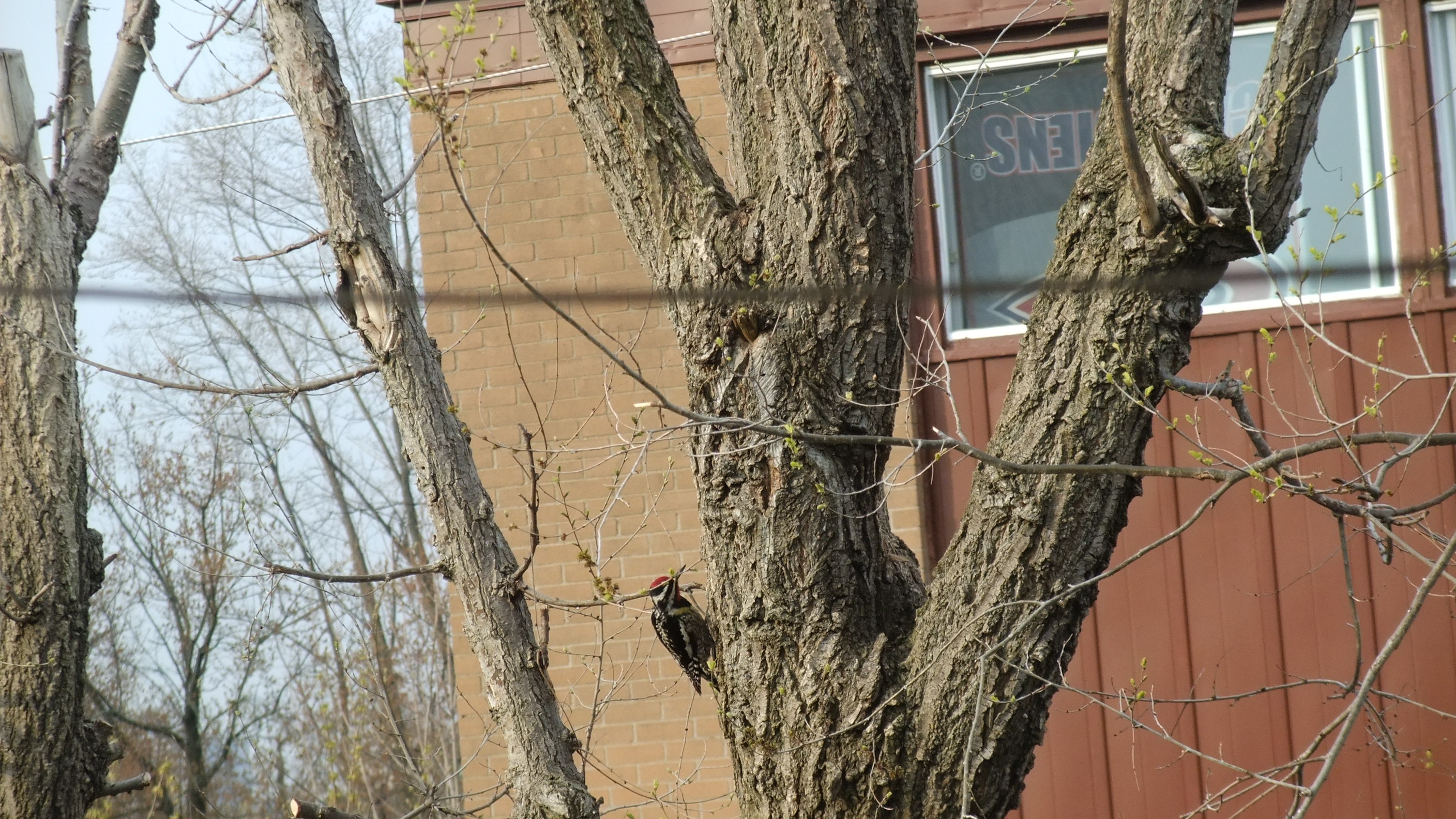 med Japanese Elms just off the balcony were two absolutely stunning Yellow-bellied Sapsuckers (males). They were there posing for us, working their way around the tree for about 5 minutes before flying over the house to the real forest on the other side of the street. They didn’t have to land in our yard. They did that for me. They gave me 36 species, including 5 species of Woodpecker. It also put a smile on my lips at work, and surely made passers by wonder why I was so happy. med Japanese Elms just off the balcony were two absolutely stunning Yellow-bellied Sapsuckers (males). They were there posing for us, working their way around the tree for about 5 minutes before flying over the house to the real forest on the other side of the street. They didn’t have to land in our yard. They did that for me. They gave me 36 species, including 5 species of Woodpecker. It also put a smile on my lips at work, and surely made passers by wonder why I was so happy.Al has been busy all along. I should have known this, but in my narcissistic dark moments, I found myself hoping that his work load became so overwhelming, that he was unable to do birding on the wonderful Camp Heidleberg property, but was stuck in his subterranean office, unable to get out until after dark. Sure he could still add some owls, I thought, but owls would not be enough to match the flood of Gatineau birds. Today I received this message from Al. Instead of losing interest, dropping the ball, or being overwhelmed with work, he has picked it up and is running hard for a touchdown. I’ll let his story do the talking:
“Today I had a Chipping Sparrow to bring my total to 60. A few recent additions are Ruby-crowned Kinglet, Vesper Sparrow, Myrtle Warbler, Pine Warbler, Yellow-bellied Sapsucker, Tree Swallow, and Swamp Sparrow… I managed to get both Eastern Screech and Great Horned Owls one evening, but no Woodcocks seem to use the property for breeding. I looked at the list from last year and compared it to this year. Based on that I should be able to get 109 without much trouble, as long as I detect the same number of warbler species as last year. It is pretty cool to compare lists from 2011 and 2012 at this point – the majority of migrants have not yet returned, but 60% of my species have already been detected. I am not sure what will be next, but my guess would be Eastern Kingbird or Broad-winged Hawk.
Your totals sound great and I am impressed some of the species you have gotten from your place!
Species you were dreaming of, eh? … I do not yet have Great Egret, but I think I would dream up a Yellow-billed Cuckoo for this year. It is a possibility, for sure.” OK, wait and see Al. My next species will either be a Great Blue Heron or a Brown-headed Cowbird! That is my prediction.
|
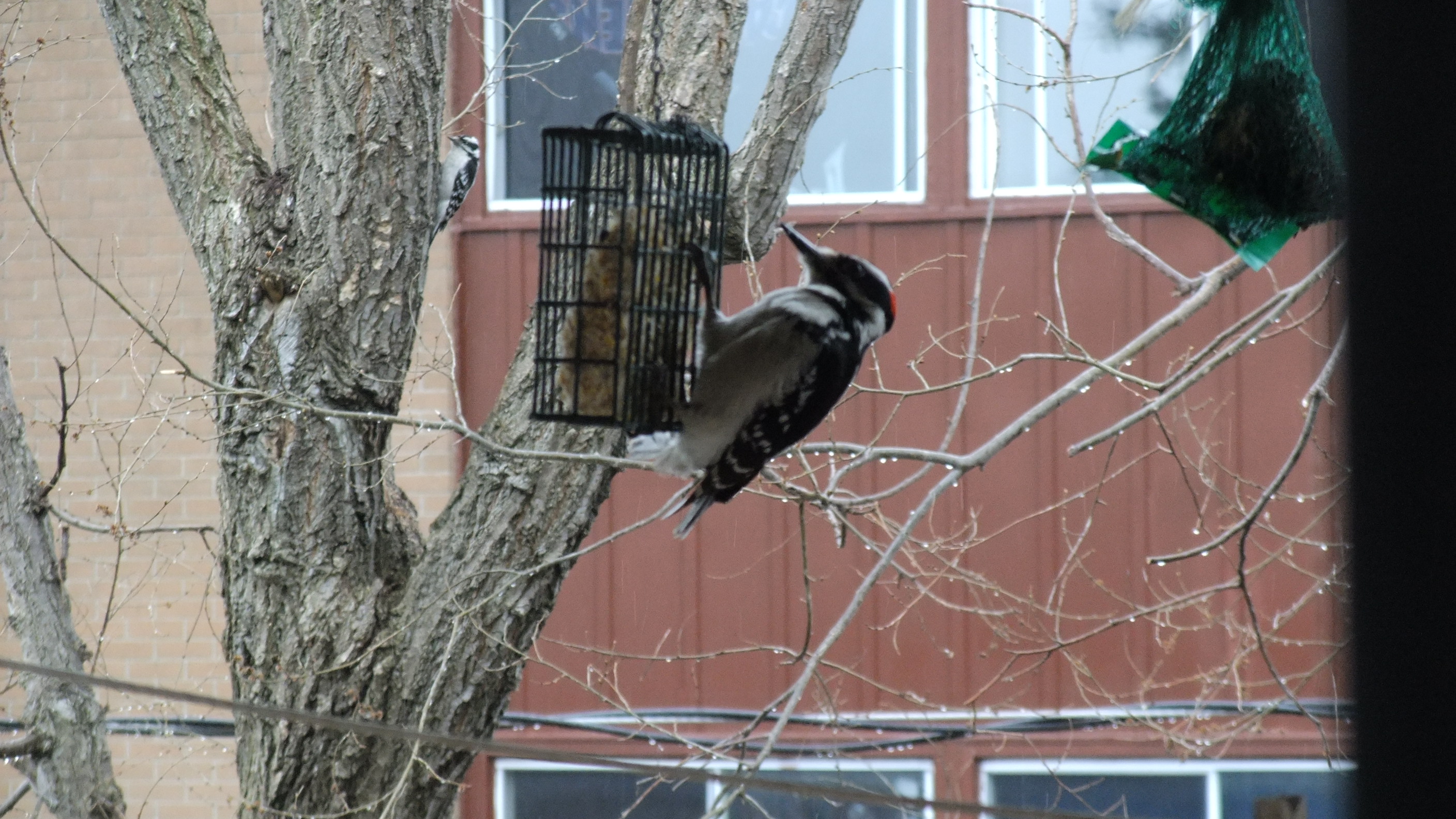
Notice how much larger the Hairy is compared to the Downy in Gatineau
On March 12, having just observed species 19/20, I mused that my goal would be to match Al’s February 29th total of 31 species by the end of March. This year I definitely had the weather on my side. Warm air flooded into southern Canada shortly after that post, and for about a week, from the 16th to the 23rd, the temperatures soared to summer values of 26 degrees C. The snow pack evaporated before our eyes, and suddenly new birds showed up. On March 16th, a lone Killdeer, announced its return as it sailed high over the neighbourhood northward over Gatineau Park starting a flood of new species for me. On the 17th, Red-winged Blackbirds appeared, as did a few Cedar Waxwings in amongst the Bohemians. On the 18th, Common Grackles joined the neighbourhood fun, taking control of the tallest trees. Scoping the river proved worthwhile for me, (I do this right out on the balcony, so that it does not look as if I am creepily peering into ‘houses), as I picked out a small line of Double-crested Cormorants moving west. Mallard, Common Merganser and Herring Gull added to the number.
On March 22rd, I had some time to bird while preparing for a trip to Quebec City. I knew that when we returned it would be colder, so, with the east window over rue Boucherville wide open to lean out over the roof and look and listen into the strip of Gatineau Park that is adjacent to the house, I heard a remarkably early Eastern Phoebe singing in the distance. To cap it off, the Pileated Woodpecker announced itself with its loud ringing call, and flew from the park to a telephone post a few houses away. This was the species that my wife had watched with delight, but which I still had not observed. By the time we closed the trunk of the car and began our trip I was already at 30 species. Turkey Vulture and the strangely elusive Blue Jay rounded out the list on the 31st, putting me at 32 species. Finally, I woke to the song of a White-throated Sparrow on April 1st.
It is worth noting that I identify many species from the bed. The Blue Jay was another one that I heard while in bed. Many birds sing or move around early in the morning at sunrise or a bit before when I prefer the warmth and coziness of the bed. But my ears are always working hard. This brings me to my final note. I so much enjoyed this birding from the balcony business in March, that twice I woke up remembering dreams of birding from the balcony. Yes, I am dreaming about birding from our apartment. In the dream I remember, I was scoping the river and watched a Great Egret sail through my field of view. A few days later I heard that Egrets are back around Montreal. This leads me to a dilemma. Should I start a third category (in addition to my list and the “family” list) of “all inclusive consciousness list” so that I can include dream birds observed from the balcony? Should I highlight the ones heard while in bed? More will be told later. . .
Six days into March, Al sent me message. At Al’s Outdoor Education Centre, March is Maple Syrup month, so he spends a lot of time outside setting up and taking down equipment for this. It is a good time to be outside lots of birds are on the move, including some big waterfowl. Here is Al’s story:
“While standing by the sugar shack with Sean and Peter on Thurs(?) of last week, I interrupted Sean telling story as I pointed out a RWBB, and then again when I heard Tundra Swans flying over! I ran out to the field to try to catch a glimpse and we counted 40 as they ducked in and out of the whispy clouds that dotted and otherwise blue sky. Their white bodies were beautiful against the blue background. We again began chatting and 3 Common Grackles Flew over. And while watching the grackles, a group of 3 geese flew nearby, composed of 2 Canada’s and 1 SNOW GOOSE!! Snow Goose is a new species for the property in general and was the 4th new species of 2012 in a span of 10 mins! The day continued to be great, with Killdeer calling in the afternoon, and 3 Snow Bunting”s called repeatedly as they flew over me as I headed up to the top end of the sugar bush! And as if there were not enough, a Cooper’s Hawk flew over me as I headed to the building to get something to eat…
What a day March 2nd turned out to be!! SEVEN new species for 2012, and a new species for the PROPERTY, also!
Going into that day I had 30… now… 37!” – Al
Yesterday we were skiing in Gatineau Park on 30 cm snow base. Around the city though, the signs of spring are there after two days a well above freezing and rain on Wednesday. So today, Sunday, first day of daylight savings time (which I hate), the table is set for me to finally add some birds to my paltry list from the balcony. A warm front gently drifted in over night, bringing sun, high pressure and 11 degrees C of heat. I am stuck at 16 species (Ring-billed Gull 13 days ago was the most recent), or 17, depending. In last blog, you may recall that there was an issue of whether to count 15 or 16 species (before the gull). The question was over a Pileated Woodpecker. I did not see or hear it. . . but my wife did. She couldn’t miss it. It was in the tree, about three metres from our tiny suet feeder about 18 days ago. This was during the day when I was at work with Nature Canada. She saw the giant, and watched it for a minute or more while it considered what to do before flying off. Next thing, my phone rang at work “honey, there is a giant “pica-pau” (Portuguese for woodpecker) on the tree with big red hair.” She was very excited! Rather that suggesting what it might be, I asked her to check her new laminated Ontario bird guide. Immediately she found it and proclaimed “hey, we are at 16 species!” I could feel her smile on the other side of the phone, and I am sure she could feel mine. So, though I have not observed the Pileated, I think that from now on there are two lists we keep – the “my” list and the “our” list.
Now, getting back to today. First new species is one that has been streaming into the region over the last week or so, but is a bit slower to get to the foot of Gatineau Park where we live. American Robin. Late this afternoon, the Robin’s beautiful song was joined by the base-line of a Mourning Dove’s coos (also new). Finally, and I am sure that all of you are guessing what the next will be . . . it was a long string of honking Canada Geese passed directly over our balcony, guiding themselves west north-west along the Ottawa River. So, depending on how you count it, that makes either 19 or 20 species! And March is barely begun. I will set my sights on 30 species by the end of the month, just as Al had done so for February. I suspect that I will always be about one month behind him:)
A good friend and ex-colleague in the awesome Outdoor Education Department of the Waterloo Region District School Board, Al, inspired me to do this big year, so it is only fitting that readers of this blog get to hear how Al is progressing in his big year from the workplace. He sent me his first post a little over a week ago and an update in the last few days. His workplace is the Camp Heidelberg Outdoor Education Centre. The actual office space is not one for birding from (a basement), but once outside, it is a lovely natural area just north west of Waterloo with mixed forest, wetland, bog, upland forest and some open areas and a good view of open fields to the north. I’ll ask him to send me a picture or two so you can see what Camp Heidelberg OEC looks like.
He wanted to be at 30 species by the end of February, (so do I though I am stuck at 15 or 16 which I will explain in the next entry). So here is what Al has to say:
“I have been keeping track of the species diversity of birds on the property where I work, since the fall of 2000. To date I have had 147 species! I had never kept track of the number of species detected within a single year, but in 2011 I began using eBird to contribute my sightings as part of citizen science. One of the benefits of eBird is the automatic tracking of species over a calendar year. Although I might have had 100 species in a calendar year before, but never knew it. Last year I had 111 species detected on the property! This year, as Ted blogged, we thought it might be interesting to have a friendly competition to see who could detect the greatest number of species for 2012. In January I detected 25 species, with another 2 added so far in February – for a total of 27 species. I have been trying to keep special attention to listening for Common Redpoll, Hoary Redpoll, Bohemian Waxwing, White-winged Crossbill, Snow Bunting, and other ‘winter’ specialties – because if we don’t get those now, chances are slim at the end of the year… On Friday I was filling my bird feeders and saw distant flock of finches. I assumed they were WW Crossbills, due to how common they are this year, but then noted the irregular flight acrobatics, more typical of HORE, CORE, and PISI. They then flew into the trees right above me and I ‘ticked’ Common Redpoll – a flock of 40-ish!
I have struck out on Snow Bunting, and have not been out owling (I am not spending any addition time beyond my regular work times), but WW Crossbills, Pine Siskins, and Common Redpolls are now on the list. It seems that the finches will be detected more frequently at the feeders, with the dropping of seeds from the cones and the birches in the area. COME ON HOARY REDPOLL!! It is not likely this year, but I will be sure to look at each bird, just in case…
I think if I can approach, or get to 100 species it would be considered a very good year… more than 1/4 of the way there. I need a Harrier, Snow Bunting, or any owl species… Thirty species by the end of the month would be a wonderful winter birding list.
Al ”
and he updates from this past Wednesday:
“Today with the class we were doing some bird watching and not only did we watch a Pileated Woodpecker (PIWO) at the suet feeder, but we saw the 30 species for 2012. It is an uncommon species that we might see 5-10 times per year in the ‘birding area’. We were watching BCCH eating at the back feeder and I was telling the class to watch on the ground for DEJU, when another bird popped out. I did not have my ‘bins ready because I was helping some students fine-tune theirs… one student said what is that? I and I looked up and said ‘That is bird type #30 for the property for 2012!”. I had already told them about the friendly we were having.
So #30 for me is the uncommon American Tree Sparrow (ATSP). I am missing Hoary Redpoll, Bohemian Waxwing, and Snow Bunting for the winter specialties… keeping my ears open!”
Since Al is trying to predict what he might observe next, I will do the same. I predict that Ring-billed Gull, Pileated Woodpecker, and Canada Goose will be on the list in the next week. Still no sign of any “winter finches” from our balcony. Maybe too optimistic for the goose, as we just received 20 cm of snow last night!
Ted
Last weekend I spent almost no time observing birds from our apartment and balcony. During the week, I did not spend any time at all either. Two weeks with no new species, two weeks with almost no observing. Something needs to change. So this morning, after a late breakfast, I grabbed my binoculars (bins), and stood sentry at the balcony window. Same guys as usual . . . mainly American Goldfinches. A flock of about 20 to 30 buzz around, dominating the hulled sunflower seed feeder, while ignoring almost entirely the niger seed feeder (except for the odd one that is excluded from the sunflower feeder by an extremely aggressive crowd). The Downy Woodpecker was there on the suet, and a couple Chickadees found room on the sunflower seed feeder to quickly grab a few seeds. A pair of White-breasted Nuthatches show up and are never deterred by the smaller chattering Goldfinches. After a few minutes I shift to the other side of the house, and scan the horizon Government buildings at the Portage and beyond. A pair of Ravens flies into my field of view, their distinctive shape – different from a crow’s – catching my eye, as does their beautiful choreographed flight. The two birds were flying like one, matching eachother’s dips and rises to perfection. Raven’s flying prowess and acrobacy takes my breath away. I follow them from Portage, near the Ottawa river (which I cannot see from that angle), to the Casino near Lac Leamy, then lose them from view, but gain a feeling of exhileration and joy, and satisfaction that I had at last another species to add to my Big Year.
I then went outside, with a coat and warm clothing, and sat in the minus 14 temperature in the sun, on the balcony, as the Goldfinches gradually habituated to my presence and, as long as I sat motionless, began feeding on the sunflower seed bits. Twenty minutes later there were no new sounds or species, so I came in to warm up. Almost immediately, a flock of slightly larger birds wheeled past the house, catching my eye, but not enough to be sure what they were. I rushed to the other window, but no sign of them. About 15 minutes later Cris and I went out to the car, and as I stepped out of the house, my ears were greeted to the wonderful musical trills of dozens of Bohemian Waxwings. They had in fact landed in the trees around the house, and not continued flying (I had suspected the flock I had seen a few minutes earlier was Bohemian Waxwings). What a beautiful and joyous sound they make. And, according to my wife, they put a great smile on my face. Species 14, Bohemian Waxwing. Winter resident of the Gatineau, and magnificent visitor from the northern boreal forest of Quebec and Labrador.
I was very happy with the results of 30 minutes or so of birding – 2 new species, and a good discovery. . . I realized that I can see the Ottawa river – sort of, from the balcony. Though it is only a small area between two buildings, and once the deciduous tree leafs-out the view will be obscured, I am sure it will prove valuable in the months ahead with getting me some new species.
Ted
 birdingfromthebalcony