Ted’s Birdathon for the Bruce Peninsula Bird Observatory: The Account
I think it was in 1982 or so that I did my first birdathon. I don’t recall much, except that those first several years of birdathons, I would wake up at 3 am and be out of the house or tent by 3H30, chasing after owls and rails, and listening for the few nocturnal flight calls that I had learned by then. About 20 hours later, after trying for those owls that we missed in the morning we would return to a campsite, red-eyed and over stimulated from nonstop concentration. Those first birdathons were for the Long Point Bird Observatory and often took place in the fabulously diverse Long Point area. Nineteen years later, a few of us established the Bruce Peninsula Bird Observatory (BPBO) and its migration monitoring station at the northeast tip of the Bruce Peninsula. As a founding Board member, BPBO became the object of my fundraising efforts. For many years, my buddy, and a co-founder of BPBO, Rod Steinacher and I would do birdathon together. Our area was generally from Cape Hurd to Cabot Head, along the northern tip of the peninsula, and in better years would yield upwards of 120 to 130 species, sometimes more. We were careful to limit our driving and in fact spent most of our time on foot. Probably starting about 12 years ago, we would end up at Rod’s place sometime in early to mid-afternoon, otherwise known as the “dead zone” for observing lots of birds. It was easy to justify a short nap. Each year that short nap grew a bit longer, and maybe would morph into an early supper before heading back out for an hour or two of birding before dark. We would end our birdathon at the iconic Crane Lake, now part of Bruce National Park. I am pretty sure that our midday siestas had nothing to do with lower species counts in the latter years of our upper Bruce birdathons. According to a major study from USFDS and others, North America lost 3 billion birds between 1970 and 2020. That surely had to be the reason why our birdathon tally had dropped, and not the afternoon naps.
The last several years, I’ve done a “green” birdathon – meaning really just sticking close to our home in Gatineau and moving by foot or by bicycle within a three kilometer radius of our house. This year, I chose May 24, 2024, as birdathon day. I chose it because it was a Friday, I didn’t have work meetings, and it was literally the only day in May without other obligation, except for the ones I forgot about.
To maintain tradition, I was up at 4 am, and after 15 minutes of searching for my bike light, and confirming that I probably had left it in Cuba, I found my wife’s bike light which served my purposes.
Going outside, I was struck by the cool temperature – around 10, accompanied by a light wind. I was wearing my cycling shorts, a light t-shirt and a very light windbreaker. As I rode in the dark up the street, I realized how cold and quiet it was. Onward I went along the bike trails through the Corridor Champlain, and the two kilometres of forest. Birds were awakening. An Alder Flycatcher whirred in the distance. Wood Thrush song filled the forest. All of the breeding warblers revealed themselves, one song at a time, almost like I was in Bobcaygean. But I wasn’t. I was in the forest near my home and when I returned just after 6H00 am, I am pretty much certain that my core temperature was around 30C. You know that point when you are too cold to shiver? I was close, to that point, but I had accumulated 44 species in about 90 minutes, so that was promising. What wasn’t promising though was the wind. An icy wind was picking up and in those 90 minutes it went from a steady breeze to near gale force, causing tree limbs to sway and the forest canopy to roar. When considering weather conditions that make birding tough, after torrential rain, this type of wind is pretty much the worst. However, as the wind was from the northwest, I was confident that I could find sheltered areas that might have birds.
These were my thoughts during my hot breakfast. Perhaps, I thought, I could find even more clarity in my thoughts if I lay in the warm bed for five minutes or so. The bed was irresistible. Yes, maybe one of those 5-minute power naps would refresh me.
Ninety minutes later, I woke in a start, realizing that I missed one of the key parts of the day. I looked gloomily outside and saw trees bending in the wind. Maybe I didn’t miss much. But I gathered up my courage, dressed more warmly, and went back out on my bike, this time with the spotting scope strapped on the back. I headed toward the lookout behind l’Université du Quebec en Outaouais. From my perch above the river, I could see a few of the bird colonies on islands within the Ottawa River – mainly occupied by Ring-billed Gulls and Double-crested Cormorants. Careful examination of the large bare lump of rock covered with Ring-billed Gulls revealed a pair of Herring Gulls at the very top, in their “office.” To the right was another colony but on a densely forested island. The dominant species was Double-crested Cormorant, but I had a hunch other species were present. I decided to focus on one area where there was a bit of a gap in the trees. After a couple of minutes, a large pale bird flashed some feathers then disappeared behind the foliage. “Stay with it” I said to myself. Eventually I was rewarded with a better view. Grey colour, head plume – a Great Blue Heron. But something else was there, smaller. I was going to be patient and after ten minutes a Black-crowned Night Heron dropped to the ground below a tree and quickly disappeared, but not before it was on my list. Other birds were active around me. A small flock of Cedar Waxwings flew out from below me. A pair of Rough-winged Swallows swooped past. Gradually the numbers grew. I left the lookout and rode west along the bike path past the Champlain bridge and towards a small wetland on the river near Baie Simard. Outside of an out-of-place Ring-necked Duck, none of the usual waterfowl suspects were to be found – no Wood Ducks, no Mergansers, no shorebirds and no evidence of any migration. Was it over? I found a pair of Killdeers in the muddy derelict lot near the big mall off Plateau, and a few other species before returning home. I arrived a bit after 1 pm, very hungry and needing an energy boost with 69 species logged.
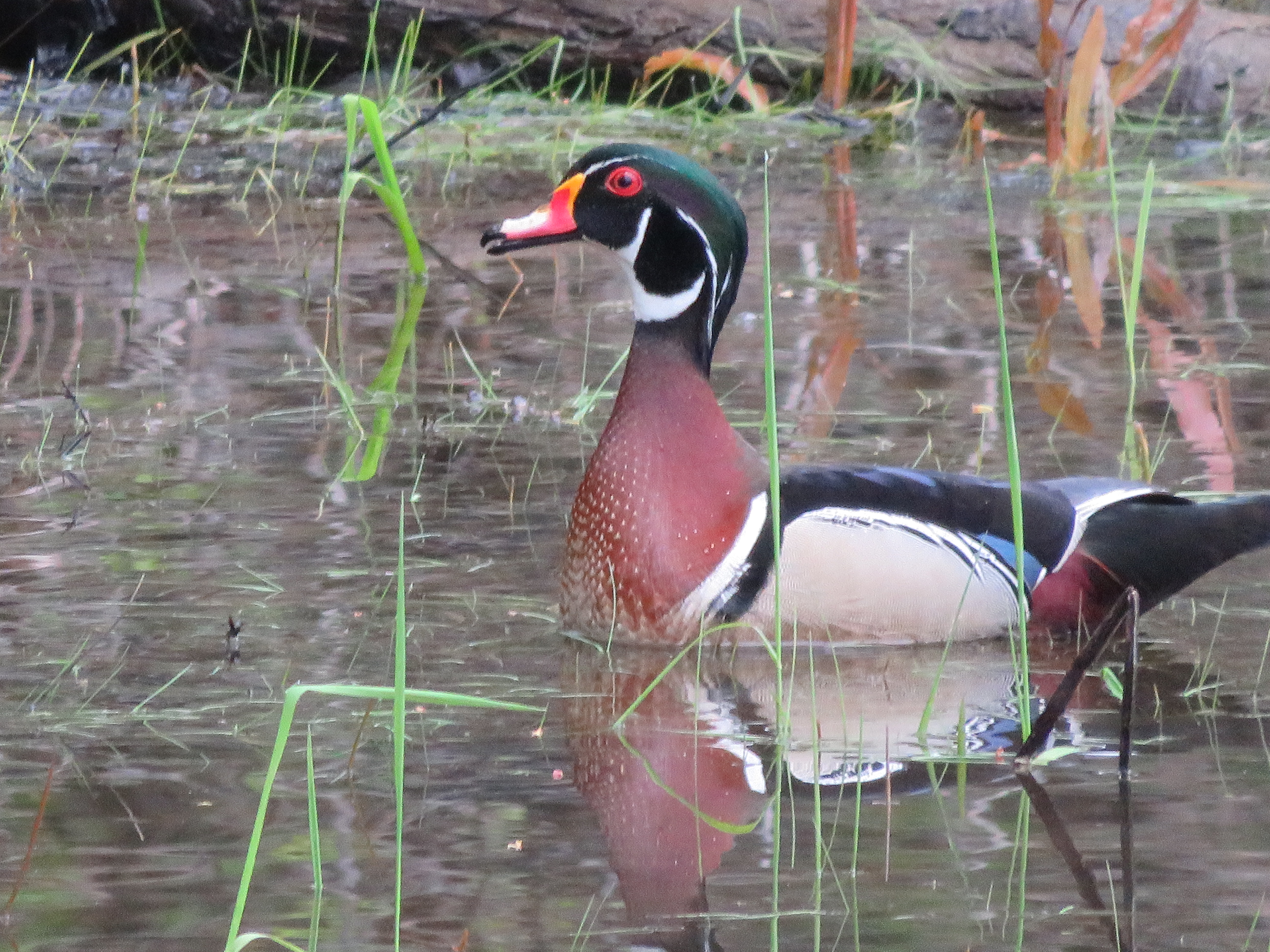
After lunch, I realized that, in fact, I did have obligations and would have to put my birdathon aside for a few hours. I had to prepare for a bird banding outing the next morning, which meant driving to Luskville about 40 minutes away and checking out the property where I would be banding. When I got back, I was reminded that it was the last gymnastic class of the year for my grandkids. We had to cross the river into Ottawa to find the gym near the big Ikea building. After the class, we went to Ikea for a classic Ikea meal. For a while, I forgot I was supposed to be birdathoning, but at 7:30 pm I remembered. We rushed home and minutes before sunset I headed out again on my trusty horse, (I call my bike “my horse” sometimes). Just before leaving, Cris, my wife, asked me if I had a plan. “Yes” I said. “I need to get to 70 species.” “How?” she asked “It’s almost dark.” “With the ‘wood’ birds” I said. Three minutes by bike from our place is a storm water management pond – a good one – with lots of natural vegetation and an island in it. “There must be a Wood Duck there” I thought. BINGO, there was a pair. I barely needed to stop to see them, then I was off to a spot where we had observed an American Woodcock doing its fabulous courtship display about three weeks before. I arrived there a few minutes later – too early for Woodcocks to be displaying. The sun had just set, and typically they don’t start calling and displaying until about 20 minutes after sunset. I decided to ride through the Champlain corridor again and check the area on the south side which was open scrubby forest, good habitat for Woodcocks. Along the way, a Northern Waterthrush sang – new to my list. Finally near the golf course, the night was swallowing the day, and I heard that distinctive “peent” of a Woodcock, rounding me out at 72 species.
So that’s my story. It was a different birdathon. Very late in the migration season, though I did detect many Swainson’s Thrushes, which were clearly migrating. But other than that species, I think that most of the observations were of breeding birds. It was still fun, but challenging.
I want to thank those of you who supported my birdathon for your generosity. I still need a bit more to get us over that $3000 target. Please consider helping us get there. To sponsor me, or top up your contribution, just follow the link to my birdathon page by clicking here.
Thank you so much!
Ted
 birdingfromthebalcony