A week at Cabot Head including the birdathon big day one.
It is a pleasure to share with you an account and description of my week at the Cabot Head Research Station of BPBO, including one of my “birdathon” efforts. I am grateful that you are considering or have sponsored my birdathon and by doing so, you are making a meaningful contribution to BPBO and to bird conservation. Please go to this link to sponsor me, if you have not already done so. I hope to raise over $4,000 in the birdathon, and most of that would support BPBO.
Cold! Bloody cold some might say. That is one way of describing the weather during the week. I was reminded of our several suffering volunteers from the south (mainly Nicaragua) over the years who spent approximately one month at the station in the spring. The geography of Cabot Head results in much colder temperatures than even a few kilometres inland. Surface waters in Georgian Bay and Lake Huron, that are metres from the Research Station, are about four to six degrees Celsius until mid to late June. This acts like a giant refrigerator for Cabot Head. On top of that, the actual weather much of this spring was colder than average. Despite the fireplace with an insert and recently replaced sealed window units, Wingfield cottage, where we stay, was always cold inside, except one day when the fireplace was roaring.
Ideally there should be three or four people making up the crew at the research station in the spring to cover all of the demands of extracting birds, banding, census and casual observations. There is the ideal and then there is reality. Reality is that volunteers cancel at the last minute (for all sorts of good reasons) resulting in gaps in personnel. Such was the case for me last year, as the guy who cancelled last minute due to my eye injury. This May, a few people cancelled, including a replacement volunteer for a cancellation, leaving just Stéphane and myself for one of the potentially busiest weeks of the year. As I am an experienced bird bander and skilled observer myself, and Stéphane is one of the best in the business, we were able to maintain full coverage.
One of the wonderful things about Cabot Head Research station is the facilities there. There are two fully functioning cottages – 1960s era – that have largely been restored by BPBO with the support of Ontario Parks, Ontario Trillium Foundation and various donors. These cottages are fully equipped and in fact rented out to stewards between June 10 and August 15, as a way of funding our operations and keeping a presence at the site over the summer. To find out more about summer stewardship program, click here.
The lights and pumps run off electricity generated by solar panels (soon to be augmented by a small horizontal wind turbine). We are 100% off-grid. There is a new septic system, and Ontario Parks staff test our high quality well water biweekly. Volunteers stay in a dormitory-like bedroom that can sleep up to four people. Other accommodations are available at Grebe lodge, about 30 metres away! It can hold up to 10 people.
One of my main contributions over the week was doing the census each day. Census is the only standardized sampling method that is done every day regardless of weather. I always find it thrilling, challenging and extremely enjoyable. Census starts on the steps of Wingfield Cottage, overlooking Wingfield Basin with the Middle, West and Bolder Bluffs in the background. After scanning the basin, the sky and recording any birds heard or seen, the census taker proceeds to the rocky tip of the peninsula through about 50 metres of scattered cedars and shrubs. Straying from the path exposes the observed to copious Poison Ivy but also affects the sampling area, so the census taker must stay close to the route and move at an adequate pace to cover the area, leaving a few minutes at the end. The census route ends at an area we call the Jack Pine barrens. It is anything but barren. This fascinating habitat consists of large openings of grass and sedge – dominated alvar, which can be either very wet or very dry, with coppices of Jack Pine. The entire area is a patchwork of openings and forest patches. The alvar is dotted with rare and threatened wildflowers, and is home to Black Bears and Massassauga Rattlesnakes. In the early evening in mid-May, the air buzzes and rings with the songs and displays of Eastern Whippoorwill, American Woodcocks and Common Snipe.
Weather patterns drive the migration, having a large influence on the number and diversity of bird species. The census results reflect the local weather conditions. For example, on Wednesday, I only observed 11 species. During census, the wind was from the north northeast, and it was cold. As Cabot Head is on the northeast corner of the Bruce Peninsula, it stands to reason that the 17 km cold wind from the NNE would drive birds away from Cabot Head, and the low temperature of 1 degree would mean less feeding activity. Two days later, the wind was south, and the temperature 7. The result was 64 species in one hour, as birds were brought to the tip of the peninsula, and had nowhere to go.
| Date | # of Species | Temp at start | Wind Speed | Wind direction |
| May 15 | 32 | 4 | 12 | SW |
| May 16 | 49 | 11 | 19 | SW |
| May 17 | 11 | 2 | 17 | NNE |
| May 18 | 46 | 1 | 13 | N |
| May 19 | 64 | 7 | 7 | S |
| May 20 | 37 | 8 | 14 | SW |
| May 21 | 38 | 8 | 11 | W |
I will call Friday the 19th as one of my birdathons, because I observed lots of birds that day! Prior to census and opening the nets, I walked to the Jack Pine Barrens to hear the last of the American Woodcock’s twittering display and the Eastern Whippoorwill plaintive calls. An early Wood Thrush sang before sunrise, and I detected the call notes from Swainson’s Thrush, Gray-cheeked Thrush and Veery. While unfurling the nets, the hoarse notes of a Scarlet Tanager caught my attention. Then a Baltimore Oriole, then vireos. Suddenly the trees were filled with chips and squeaks and beautiful songs. There were so many birds around. At the start of census, a small group of shorebirds flew past me along Wingfield Basin. It was a group of Least Sandpipers, led by one noisy Ruddy Turnstone! A few minutes later, while looking out over Georgian Bay from beside Grebe Lodge, I observed a spectacular phenomenon in which dozens of small songbirds dropped out of the sky over Georgian Bay, desperately trying to return to the safety of the forests at Cabot Head. They had overflown the tip of the Bruce Peninsula during their nocturnal migrations, and chose not to continue across the 90 kilometres of Georgian Bay to the north shore, instead returning to the safety of Cabot Head. In the past, I’ve seen Merlins and even gulls roosting along the shoreline, flying out to attempt to capture and eat these tired migrants.
After census, the mist netting became busy. Surprisingly, all of the 15 nets were effective that day, each catching several birds. By the time we closed the nets we had captured and banded 113 individuals including record numbers of Bay-breasted Warbler and Tennessee Warbler, and near record numbers of Blackburnian Warbler.
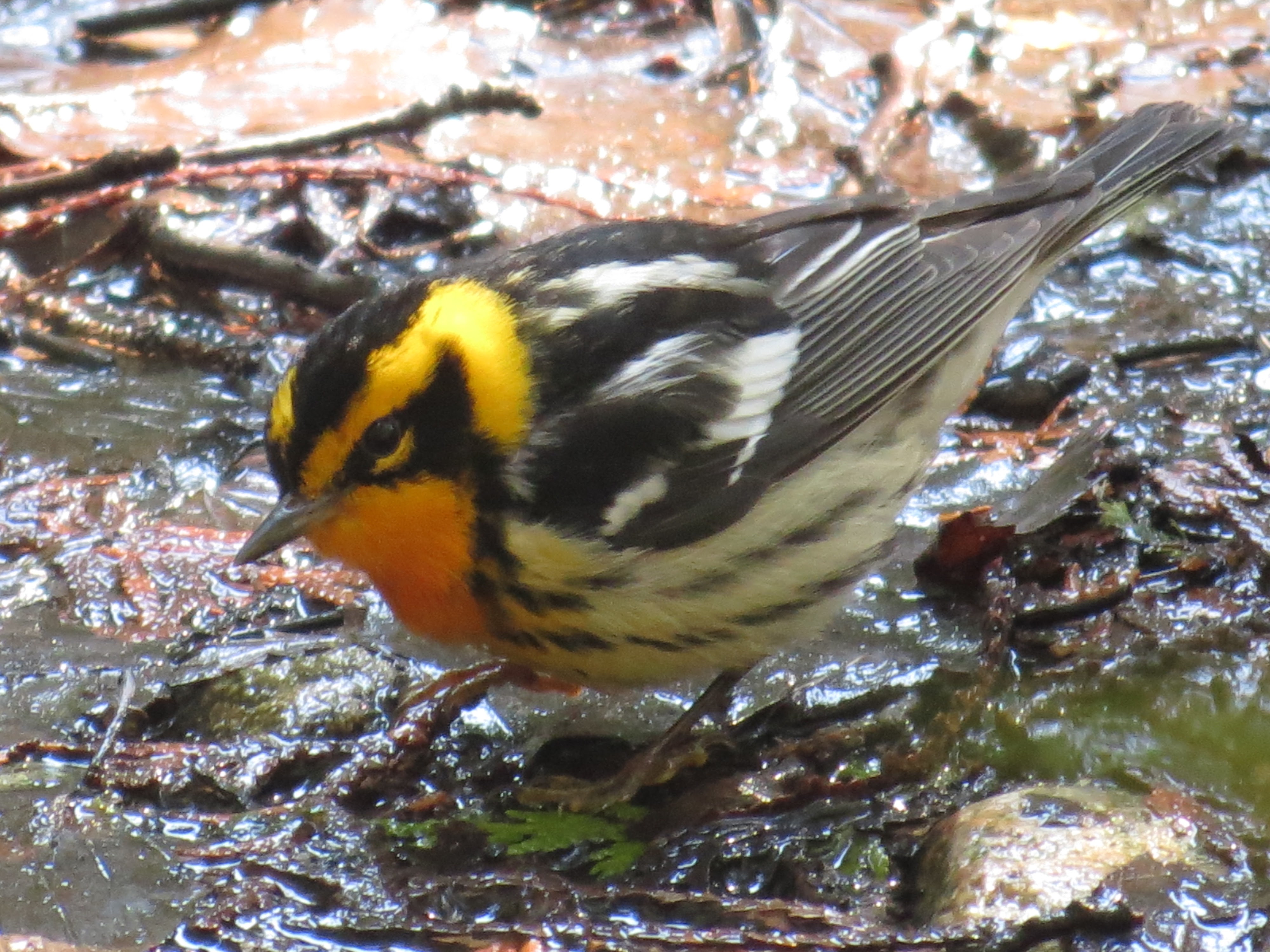
I continued birding around Cabot Head into the afternoon (beyond the count period). Common Nighthawk was the final species noted on what turned out to be a remarkable day with 95 species recorded within the count area for BPBO at Cabot Head.
After the warmth and richness in the bird world of Friday, Saturday brought cool temperatures and misty rain, preventing us from opening any nets. Fortunately, Stéphane made a roaring fire that gave us some much appreciated warmth, and the only fire of the week, despite a few below zero mornings, and a few days that did not get warmer than 5 degrees. I am so happy and grateful for my week at Cabot Head and to be able to share some of my experiences with you in this post. This week allowed me to renew my own skills in bird identification and bird banding. It reminded me why I love the place and why I dedicate my birdathon to supporting BPBO’s great venture to operate its migration monitoring station at Cabot Head.
 birdingfromthebalcony